


 Foundry Robotics
 Khosla Ventures
 Marlinspike Partners
2026-10-29 · Ian Lapham
Foundry Robotics Raised $100 Million to Own the Assembly Floor. It Has Not Said What Ships Out the Door.
On October 28, Foundry Robotics closed an oversubscribed $100 million Series A to expand a 130,000-square-foot Emeryville factory where it assembles other companies' hardware under a manufacturing-as-a-service model instead of selling robots. The CEO says it is already shipping to paying customers in defense, telecom, energy, and autonomous vehicles, but neither the release nor the factory tour numbers name those customers, quote a unit count, or show throughput per robotic cell.
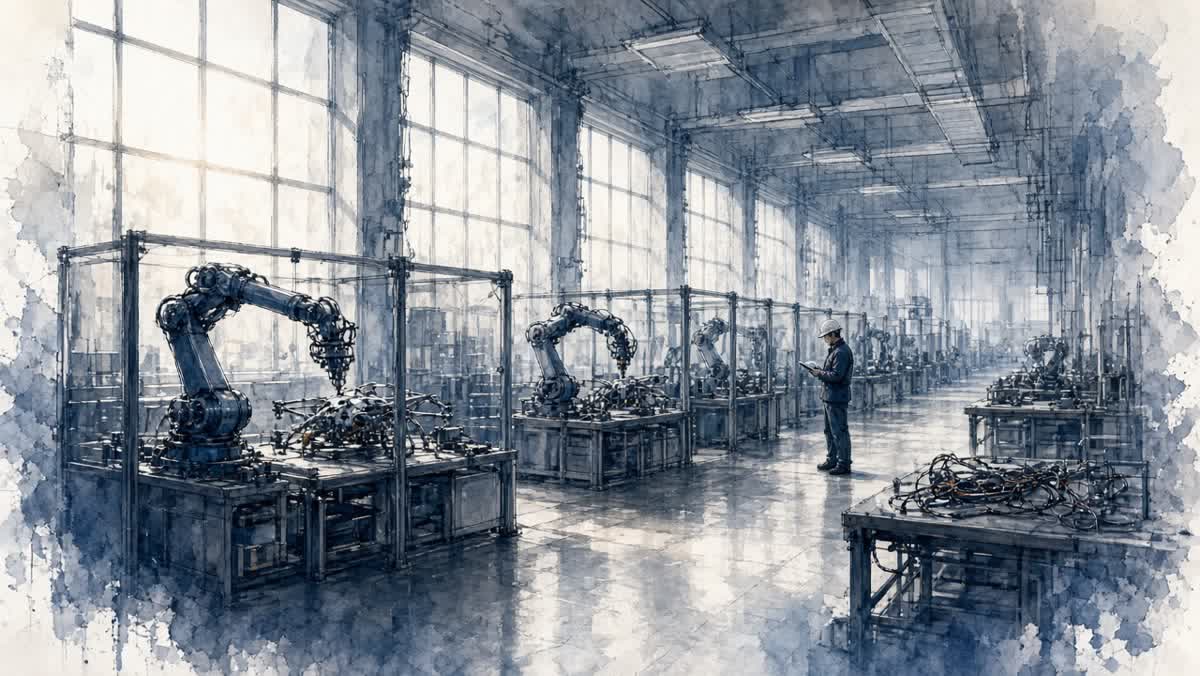
Foundry Robotics said on October 28 that it closed an oversubscribed $100 million Series A led by Marlinspike Partners, nine months after a $13.5 million seed led by Khosla Ventures (Business Wire, LinkedIn). The money goes toward a 130,000-square-foot assembly plant in Emeryville, California, where the company runs robotic cells and human manufacturing teams for defense and commercial customers. Foundry does not sell the robots. It sells capacity inside a factory it owns, under what it calls manufacturing-as-a-service (Foundry).
Our view: this is a bet on owned throughput, not another robot launch. Most robotics financings this year fund arms, humanoids, or software licenses. Foundry's pitch is capital equipment plus floor space plus FoundryOS, the agentic stack that ties cells, schedules, and cloud models together (Business Wire). That only works if units actually leave the building at a margin. Chief executive Adarsh Kulkarni said on X the same day that Foundry is "already shipping to paying customers across energy, telecom, autonomous vehicles, and defense" (X). The funding release names product categories, from drones and wire harnesses to satellite subassemblies, but not customers, volumes, or rework rates. Until those numbers exist, the Series A proves investors believe in flexible assembly. It does not prove the factory clears a utilization hurdle.
What the money is buying
The release says Foundry "expanded its manufacturing footprint twentyfold" to 130,000 square feet (Business Wire). The company's factory page repeats the 130,000 figure and lists "75+" team members across robotics, software, and operations (Foundry factory). Site badges mark the operation ITAR registered and CMMC 2 compliant, which matters for defense work even though the release does not tie a specific program to the plant.
Participating investors include returning Khosla and Red Glass Ventures and new checks from SE Ventures, Wing VC, and Axiom Ventures, plus Hanabi and Zero Shot Fund (Business Wire). Marlinspike managing partner Mislav Tolusic, quoted in syndicated release text, pointed to "quickly signing customers" (Unmanned Times). Signing is not shipping. The gap between the two is where this story will be won or lost.
Manufacturing-as-a-service, spelled out
Foundry's model puts the capex on its balance sheet. Customers are meant to move "from design to production in weeks" without building a dedicated line or paying for retooling, while Foundry trains assembly models and deploys them in a grid of cells (Business Wire). FoundryOS coordinates those cells in real time, according to the factory page (Foundry factory). The release argues feedback loops matter: a cell that builds a drone today should learn from every run and apply that to a different product tomorrow (Business Wire).
Kulkarni, in the same syndicated text, said U.S. factories need to be "rethought from the ground up" and that Foundry intends to "own the entire final assembly stack" and "own the buildings that manufacture for our customers" (Unmanned Times). That is the opposite of selling a robot arm to an integrator or leasing a humanoid by the shift. It is also why $100 million is table stakes. Emeryville rent, robots, and payroll for 75-plus people consume cash whether or not a second SKU is qualified.
Why defense quotes appeared in a funding release
Duane Fotheringham, president of HII Unmanned Systems, appears in the release text with a capacity warning: "Production capacity is a national constraint on getting unmanned systems to the fleet," and praise for Foundry's "autonomous assembly" approach (Unmanned Times). That is an industry pain statement, not a contract disclosure. Foundry lists underwater vehicles and ground robots among applications (Business Wire). It does not say HII is a customer. Treat the quote as evidence that shipbuilders feel the bottleneck. Do not treat it as backlog.
Co-founder Emmanuel Lamacchia's background, in the syndicated release, is Tesla's Model Y program; Kulkarni's is Ghost Robotics and Scale AI's robotics business (Unmanned Times). The pedigree explains why Marlinspike would fund a factory instead of a single robot form factor. It does not substitute for yield data.
Objections
"$100 million at Series A is validation that the factory already works." Partly. It validates that investors will fund owned capacity in 2026. It does not publish utilization, first-pass yield, or units per week. Those are operational metrics, and they are absent.
"Flexible cells are the whole point; asking for one product count misses the model." Fair for a job shop. Even a job shop can report active SKUs, cell hours billed, and average changeover time. Foundry has published none of them.
"Defense and telecom customers cannot be named." Often true. Classified programs still leave room to report aggregate output or redacted case studies. Silence on volume is a choice until it is not.
Three things to check
- First named production customer with a quantity. A press release or filing that ties a program to a build rate, even a range, converts "paying customers" from a claim into an audit trail.
- FoundryOS metrics on changeover. If the same cell truly switches from drones to harnesses, watch for published changeover times or simultaneous active SKUs. That is the flex thesis in numbers.
- Second site or duplicate line. The release funds build-out of Emeryville only. A second geography or duplicate line would signal demand exceeded one building's capacity.