


2026-09-06 · Ian Lapham
The Arms Are Already Bolted Down
Factories are full of industrial robots that cannot handle a wire that flexes. Sanctuary is betting the way in is new software on those arms, and a 313-trial plug test is the first evidence for the bet.
Every humanoid deck opens with the same sentence. Factories were built around the human body, so a robot with two arms, a torso, and roughly human reach slots into an existing line without anyone re-engineering the line. Dozens of companies have raised billions on that premise. It treats the body as the bottleneck, and it treats the factory floor as a place waiting for a worker-shaped machine to show up at the door.
Factories are also already full of robots. FANUC, ABB, KUKA, Yaskawa, and Universal Robots arms are bolted to the floor, wired to the cell controller, fenced or force-limited, covered by a written safety case, and sitting under integrator service contracts signed years ago. Those arms are dumb in the specific way that matters. They are fixtured and taught point-to-point, and they fail the moment a wire flexes differently than it did yesterday or a conveyor pallet drifts a few millimeters off nominal. Nobody on a line is short of arms. The scarce thing is a controller that tolerates variance.
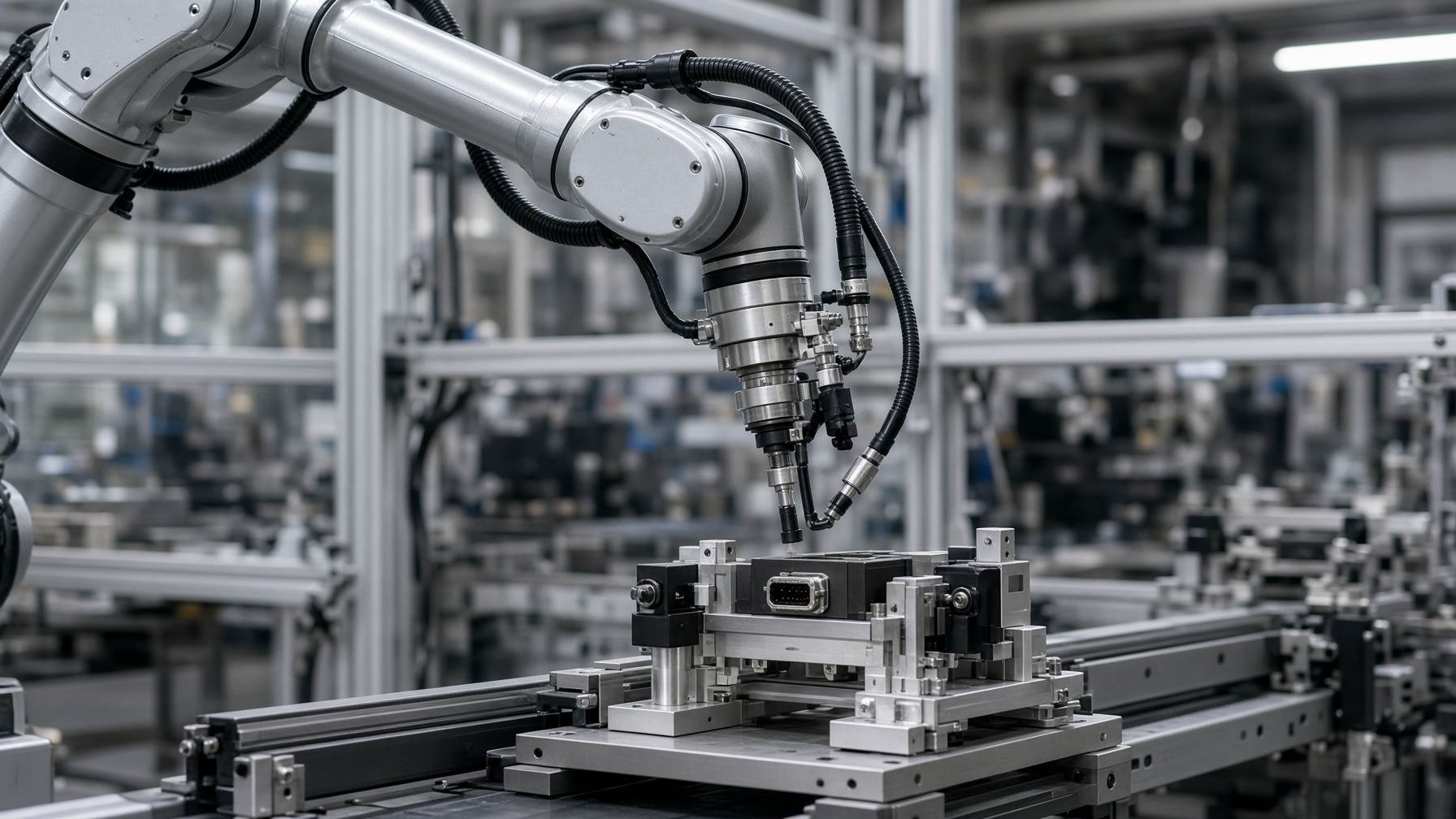
Sanctuary AI is the cleanest test of that claim, because Sanctuary spent years and eight hardware generations building a general-purpose humanoid called Phoenix, and its first customer-validated factory result did not involve Phoenix at all. The company put its control software on the FANUC and Universal Robots arm class for a Tier 1 automotive supplier and reported 99.5% success inserting a flexible wire plug into a target moving on a conveyor (https://sanctuary.ai/news/sanctuary-ai-expands-physical-ai-strategy-to-industrial-robotics-demonstrating-production-ready-ai-performance/). That was a proof of concept, and the CEO said so. But the sequencing tells you something the humanoid decks leave out. The body was the R&D vehicle. The arm is the go-to-market.
The arm is already installed
Think of the learned controller as an aftermarket engine management unit going into a chassis that has already passed inspection. The chassis carries everything the new unit would otherwise have to earn from zero. Walk the inventory for a FANUC or UR arm on a live line. Mounting and power are done. A risk assessment and safety case exist on paper and were signed by someone who still works there. The cell has fencing, or the cobot has a certified force limit. Spare parts sit on a shelf. A maintenance contract is in force. An integrator knows the site, the PLC, and the plant manager by first name. A maintenance tech already knows the teach pendant well enough to recover the cell at 3 a.m. without calling anyone.
A learned policy dropped onto that arm inherits all of it. A biped has to re-litigate every line item, starting with what happens when a full-size machine loses balance next to a person, and that single item has no settled answer in any standards body yet.
The tempo gap follows from the inventory. Sanctuary CEO Daniel Friedmann told Forbes the company's deployment target is "weeks, depending on task" (https://www.forbes.com/sites/johnkoetsier/2026/08/29/sanctuary-ai-built-a-robot-body-now-its-also-selling-a-robot-brain/). Humanoid pilots at automotive plants have been running on multi-year timelines to earn a comparable placement, with most placed on material handling rather than on the assembly conveyor itself. Weeks against years is an order-of-magnitude difference, and it comes almost entirely from not having to bring a body through the door.
The installed base is the distribution channel.
What the 40 minutes actually showed
The task, stripped of adjectives: a flexible wire with a plug on the end, a receptacle on a target moving along a conveyor, an industrial arm running Sanctuary's control system, and the customer's own production benchmarks as the passing grade. The customer is a Tier 1 automotive supplier that has not been named. Flexible wire is a real problem in harness assembly because the wire never presents the same way twice, which is why the job is still done by hand at most plants.
The numbers, as published. The product page lists 99.5% model performance, a 2.54 second cycle time per plug, and 5.5 hours of teleoperation data as the training volume (https://sanctuary.ai/solutions/physical-ai/). The press release rounds the first figure up to "99.5%+" and says the cycle time was validated against the customer's live production benchmarks. Friedmann gave Forbes the denominator: 313 insertion trials over about 40 minutes in a single session, with the 99.5% figure attaching to that run (https://humanoid.guide/sanctuary-ai-deploys-its-physical-ai-on-industrial-robots/). The product page names FANUC and Universal Robots as the integrated arm platforms and lists both custom and off-the-shelf end effectors, with Sanctuary's own hydraulic hands shown as a future configuration rather than part of this test. The control system is called Carbon. Phoenix Gen 8, the humanoid Carbon was built to run, appears nowhere in the trial.
Two company statements sit next to each other and both deserve quoting. The press release headline calls the result "production-ready AI performance," and CTO Olivia Norton's quotes carry that language. Friedmann, in the same month, described the same result to Forbes as a proof of concept rather than a production deployment. The honest picture is both sentences at once. The policy hit the customer's cycle benchmark on the customer's arm class for 40 minutes. Nothing beyond that has been shown.
All numbers are company-generated from a single proof-of-concept session; no MTBF, intervention rate, shift-length run, or ROI has been disclosed.
Task cycle is not throughput
The 2.54 second figure will get misread, so the arithmetic belongs in the open. 2.54 seconds is the per-plug task cycle, meaning the time the policy takes to complete one insertion once the arm is in position and the target is presented. That is the number the customer benchmarks its own line against, and it answers whether the policy can keep pace with the conveyor.
Now take 313 trials over roughly 40 minutes. 2,400 seconds divided by 313 is about 7.7 seconds per trial, wall clock. RuntimeWire did this derivation and it checks (https://runtimewire.com/article/sanctuary-ai-physical-ai-factory-arms-humanoids). The 7.7 seconds includes reset, repositioning the wire, any pause between trials, and whatever overhead the test rig added. Both numbers are legitimate. They answer different questions. Cycle time tells you whether the controller is fast enough. Wall clock in a 40-minute bench run tells you nothing about shift-long throughput, because the trial was never structured as a shift. Nobody ran it for eight hours. Nobody counted how many times a person touched the cell.
And 99.5% of 313 is one or two failures. No one has disclosed what a failure looked like. A dropped plug is different from a plug seated at the wrong depth, which is different from a retry that succeeded on the second attempt, which is different from a human reaching in to clear a jam. On a line, those four events carry four different costs. On a bench, they all round to the same decimal.
The result is real. Its scope is 40 minutes.
Where software still hits hardware
"Software on existing arms" is a shorter sentence than the work it describes. The arm was installed. Almost nothing else on the cell was. Someone built or selected an end effector that could grip a flexible wire without crushing the conductor and release the plug cleanly once seated. Someone mounted a camera, calibrated it against the arm's frame, and dealt with whatever the plant lighting does at shift change. Conveyor tracking had to be wired into the controller so the policy was chasing a moving target and not a fixture. And the safety case had to be revisited, because a learned policy does not follow a taught path, and the risk assessment on file assumed it would. An integrator on a real line will ask who signed the revised assessment before asking anything about the model.
Then there is the data figure. 5.5 hours of teleoperation to reach 99.5% on this task is a small corpus by the standards people assume for learned manipulation, and that is the most interesting number in the release. Sanctuary built its teleop pipeline for Phoenix over several hardware generations, and this is the first public evidence that the pipeline produces a usable policy on someone else's arm. But a data-efficiency claim only means something if it survives the next task. The next plug geometry. The next harness color. A different conveyor speed on second shift. Until a second task ships with a second data figure, 5.5 hours is one point, and one point has no slope.
"Hardware-agnostic" is a direction Sanctuary is pointing in, and the product page is honest about where it stands today. Two OEMs are listed. FANUC and Universal Robots between them cover a large share of installed arms, but ABB, KUKA, and Yaskawa are absent, and each brings its own controller interface and its own integrator base. Every added OEM is months of interface work. That is the part of "software" that still ships on a pallet.
Built a body, selling a brain
The phrase is Forbes's headline on the Friedmann interview. Sanctuary's position is that it remains a full-stack company and that Phoenix development continues. I take that at face value. Operationally it means the humanoid was the forcing function for two things Sanctuary now sells on their own: dexterous manipulation of deformable objects, and a teleop pipeline that turns hours of human demonstration into a policy. The arm is where that work first touches a customer's P&L. Whether Phoenix ever touches one is a separate question this trial does not address.
The next visible checkpoint is the Nissan Manufacturing Innovation Summit in Smyrna, Tennessee, on September 30 and October 1, 2026, where Sanctuary is scheduled to exhibit. That is a booth at a trade event. Nobody has signed anything, and the exhibit should be read as a signal of who Sanctuary wants in the room.
The crowd matters here. Physical Intelligence, the VLA model vendors, and a handful of integrator-adjacent startups all sell some version of a brain that runs on whatever body you already own. Model architecture will not be the differentiator, because architectures converge and get copied within a year. The differentiator will be integrator relationships at specific plants and the volume of production data a vendor has pulled off real lines. Sanctuary's advantage, if it has one, is that its manipulation stack was hardened on a hand with more degrees of freedom than any gripper it will ship on. Its disadvantage is arriving at the installed-arm market later than companies that never built a body. I would still rather bet on the company that already knows how hard the hand is, although that is a preference and not a forecast.
Objection docket
A plant controls lead: "A vendor ran 313 cycles of one plug in 40 minutes on a bench and published its own scorecard. Every lab hits 99.5% on a curated task. Nobody showed me an intervention rate, an MTBF, a shift-long run, or a dollar figure against the manual station. Calling that production-ready is marketing."
Concede all of it. The trial is a proof of concept and the CEO said so in print. "Production-ready" is Sanctuary's phrase and belongs in quotation marks. The argument here was never that Sanctuary proved itself. The argument is that the route Sanctuary took reaches the missing numbers faster than any humanoid program can. The trial ran on the customer's arm class against the customer's own cycle benchmark, and the next step, a line trial measured in weeks, runs on hardware the plant already maintains. A biped program has to solve balance, locomotion, battery life, fall risk, and a new safety case before it can produce the same 40 minutes of data. Weak evidence for Sanctuary is still decent evidence for software-on-installed-arms as the sequencing.
"This does not validate Phoenix as a factory worker." Correct. No locomotion, balance, or navigation was tested. Nothing in this trial tells you whether a biped can stand next to a conveyor for a shift. That fact strengthens the thesis, because the customer got a usable result without any of those problems being solved.
"Others sell the same thing." Also correct. The claim is about the route, and Sanctuary does not own the route. What Sanctuary uniquely shows is a humanoid-first company, with eight generations of sunk cost in a body, arriving at the conclusion the brain-only vendors started from.
Three things to ask any vendor selling a brain for your arms
Ask for wall clock per shift, not task cycle. Task cycle is the benchmark; wall clock is the bill.
Ask what a failure looked like and who cleared it. One or two out of 313 is fine on a bench and unknown on a line.
Ask which end effector, which camera mount, and whose safety case. If the answer to all three is "ours," the software is not the product being installed.
The arms are already there. The retrofit still has to pass inspection, and inspection is a shift.