


 Stryker
 CMR Surgical
 Intuitive Surgical
 Medtronic
2026-10-16 · Ian Lapham
Stryker Paid $400 Million for a Soft-Tissue Option, Not a Robot Company
On October 12 Stryker put about $400 million of preferred equity into Cambridge-based CMR Surgical, took exclusive U.S. sales rights to Versius, a board seat, and an exclusive option to buy the rest later. Versius Plus is cleared in the U.S. for gallbladder removal, CMR has treated more than 45,000 patients abroad, and its CEO says about 50 U.S. cases are done so far. The Orthopaedics company that bought Mako for $1.7 billion in 2013 is entering soft tissue by renting someone else's channel first.
Stryker said on October 12 that it will put approximately $400 million, or £300 million, of preferred equity into CMR Surgical, become the exclusive U.S. sales agent for CMR's Versius surgical robot portfolio, put Medsurg and Neurotechnology group president Andy Pierce on CMR's board, and take an exclusive option to acquire 100 percent of CMR's remaining equity later, subject to regulatory approvals and closing conditions (https://investors.stryker.com/press-releases/news-details/2026/Stryker-and-CMR-Surgical-announce-strategic-alliance-to-advance-robotic-assisted-surgery/default.aspx). CMR keeps development and sales outside the United States. Versius Plus is FDA-cleared in the U.S. for cholecystectomy, gallbladder removal, and CMR said in March that more than 45,000 patients worldwide have been treated on Versius (https://us.cmrsurgical.com/news/announces-45k-patients-treated-globally-as-robotic-assisted-surgery-company-makes-its-us-debut).
Two numbers belong next to the headline check. CMR's CEO, Massimiliano Colella, told MassDevice on October 15 that about 50 U.S. cases are done so far after a March soft launch, and that more than 70 percent of Versius customers globally were starting a robotics program for the first time (https://www.massdevice.com/cmr-surgical-ceo-outlines-the-path-forward-for-strykers-robotics-partnership/). Fifty cases is roughly one-tenth of one percent of the disclosed global patient count (arithmetic). The Orthopaedics company that paid $1.7 billion for Mako in 2013 is taking a slower route into soft tissue. For about $400 million it gets a U.S. bag, a board seat, and a call option on a robot that already has a real clinical trail abroad and almost no U.S. volume yet.
Our view: this is the expensive, disciplined way for a company with a hospital sales force to enter a market Intuitive still owns, without paying Intuitive-scale prices for a platform that is cleared in America for one procedure. The risk sits in the option and the indication list, not in whether CMR can find surgeons outside the U.S.
What $400 million bought, and what it left on the table
The Stryker release is careful about nouns. Preferred equity. Exclusive U.S. sales agent. Exclusive option to acquire 100 percent of outstanding equity in the future, "subject to the agreement's terms." Pierce called soft-tissue robotics "a high-growth adjacency" and "a natural extension of Stryker's strengths in endoscopy, visualization and enabling technologies," and said Stryker had "evaluated the segment carefully for years" (Stryker PR). Colella called the deal "a strong endorsement" and said Pierce's more than 30 years of MedTech leadership at Stryker would help on the board.
What is missing from the press release matters as much as what is in it. There is no purchase price for the whole company. There is no disclosed ownership percentage from the preferred stake. There is no disclosed strike price, expiry, or milestone schedule for the option. There is no claim that Versius is cleared in the U.S. beyond gallbladder. Fierce Biotech notes the company has filed a 510(k) for benign gynecologic indications (https://www.fiercebiotech.com/medtech/stryker-pens-deal-cmr-surgical-advance-robotic-assisted-surgery). Colella told MassDevice that indication is under review and expected before year end, and that 2026 was always a learning year because "we have only one indication" and were already talking to Stryker in parallel.
Compare that structure to Stryker's own history. MassDevice dates the Mako acquisition to 2013 at $1.7 billion, and notes Mako now covers knee, hip, shoulder and spine (https://www.massdevice.com/stryker-dives-into-soft-tissue-robotics-with-400m-play-for-cmr-surgicals-versius/). Soft tissue is adjacent to endoscopy and visualization, Pierce says, but Stryker did not write a second Mako check for a soft-tissue robot. It wrote a preferred check that funds CMR's R&D and global commercial work while Stryker takes the U.S. door. Colella: the money is "not exclusively for the U.S. market," and is also meant to speed R&D, with "our strategic plan remains the same."
The timing of Stryker's leadership change is background, not the thesis. Fierce and MassDevice both note that Kevin Lobo will step down as CEO at year end for Spencer Stiles, with Lobo staying as executive chair. The deal still carries Pierce's name as the commercial sponsor inside Stryker.
Versius is a cart farm, not a sealed console
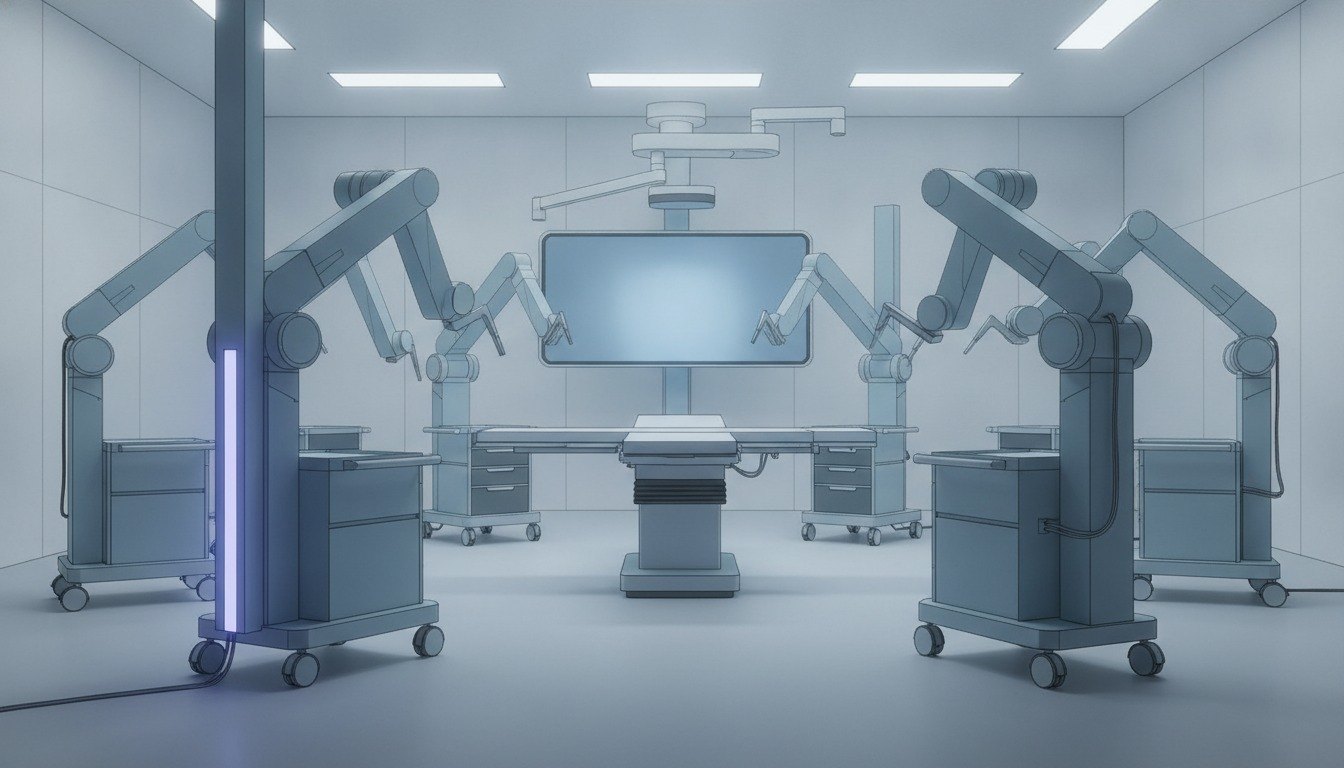
CMR's product claim is modularity. Independent robotic arms on wheeled carts move between operating rooms; the company says no dedicated OR is required. MassDevice describes Versius Plus as having wristed 5 mm instruments and 3D imaging. CMR's December 16 2025 clearance release adds an open surgeon console, a fluorescence system called vLimeLite, and a digital layer (Versius Connect for surgeons, Versius Team for hospitals) (https://us.cmrsurgical.com/news/cmr-surgical-secures-510k-clearance-of-its-versius-plus-robotic-surgical-system). The FDA cleared first-generation Versius via De Novo in October 2024, then Versius Plus via 510(k) for cholecystectomy in December 2025, with U.S. commercialization aimed at 2026.
That form factor is the commercial bet. Colella says more than 70 percent of global customers were first-time robotics buyers, and that Stryker liked the ASC and outpatient angle. He also says larger hospitals with existing robotics programs are open to adding "a very agile, nimble solution." William Blair, via MassDevice, has modeled future mix at about 60 percent in-hospital and 40 percent ASC. Those are forecasts, not disclosed bookings. J.P. Morgan's Robbie Marcus, via MedTech Dive, expects Stryker to start in lower-cost sites such as ASCs rather than going head-to-head with da Vinci in hospitals (https://www.medtechdive.com/news/stryker-enters-soft-tissue-robotics-with-400m-investment-in-cmr-surgical/832751/).
The regulatory wall is narrower than the marketing language. In the U.S., Versius Plus is indicated for adult patients 22 and older for cholecystectomy, per CMR's own safety copy. Outside the U.S., CMR lists general, colorectal, urology, gynecology and thoracic use across more than 30 countries. The gap between "broad range of soft tissue procedures" in Stryker's release and "gallbladder only" on the U.S. label is the gap this partnership has to close with filings, not with sales training.
Forty-five thousand patients abroad, about fifty cases at home
CMR's March 26 2026 announcement at SAGES put the global figure at more than 45,000 patients treated and claimed Versius as "the second most widely used robotic surgery platform globally." Stifel's Rick Wise, via MedTech Dive, called CMR roughly second or third by global installed base. We treat CMR's "second most widely used" as the company's claim and Wise's rank as analyst language; neither discloses a public system count in the sources we have.
The U.S. story is a soft launch by design. Colella: "We called it a soft launch for two reasons," the Stryker talks and the single indication. About 50 cases by mid-October is a sample, not a franchise. Training and customer support stay "completely in CMR's field and control," he says, even while Stryker carries the bag. That split is important. Exclusive sales agency without exclusive clinical support is a joint product, not a white-label Stryker robot.
The go-slow line is the one we take seriously. "We will go slow to go big." Colella wants 2027 at "full swing" after a gynecology clearance. If that clearance slips, Stryker's hospital and ASC reps are selling a one-procedure robot into a market where Intuitive ended 2025 with 11,106 da Vinci systems installed and about 18 percent year-over-year procedure growth (https://investor.intuitivesurgical.com/news-releases/news-release-details/intuitive-announces-fourth-quarter-earnings-5; Fierce Biotech's 18 percent da Vinci procedure line). Fierce's year-over-year figure matches Intuitive's own full-year messaging around 2025 procedure growth. Absolute U.S. Versius volume is still a rounding error next to that base.
Scoreboard: check size, U.S. rights, indications, volume
Medtronic's September 1 partnership with Cornerstone Robotics is the closest structural rhyme. Medtronic put approximately $700 million in and took rights to distribute Cornerstone's Sentire system in select markets outside the U.S. where it is approved, alongside Medtronic's own Hugo system (https://news.medtronic.com/2026-09-01-Medtronic-Announces-Strategic-Partnership-with-Cornerstone-Robotics-to-Further-Expand-Global-Access-to-Robotic-Assisted-Surgery). Sentire has CE Mark (May 2026) plus China and Singapore approvals. Hugo, Medtronic says, is in more than 35 countries and is expected to pass 50,000 procedures by the end of Medtronic's fiscal year. Stryker's $400 million is about 57 percent of Medtronic's Cornerstone check (arithmetic), and it buys U.S. rights rather than ex-U.S. rights.
| Stryker + CMR Versius | Intuitive da Vinci | Medtronic + Cornerstone Sentire / Hugo | |
|---|---|---|---|
| Recent check | ~$400M preferred equity (Oct 12 2026) | N/A (public incumbent) | ~$700M investment (Sep 1 2026) |
| What the check buys | Exclusive U.S. sales agency; option to acquire 100% later; Pierce on board | Owns the platform | Ex-U.S. distribution rights for Sentire alongside Hugo |
| U.S. clearance (named) | Versius Plus: cholecystectomy (510(k) Dec 2025); gyn 510(k) filed | Broad soft-tissue franchise (incumbent) | Hugo: FDA cleared within last year (Medtronic); Sentire: not framed as U.S. in the Sep 1 release |
| Procedures / patients disclosed | >45,000 patients globally (Mar 2026); ~50 U.S. cases (March soft launch through mid-October 2026) | ~18% da Vinci procedure growth in 2025; 11,106 systems YE 2025 | Hugo expected >50,000 procedures by end of Medtronic FY; Sentire multi-specialty trials completed (company) |
| Form factor | Modular wheeled carts; open console; 5 mm wristed tools | Multi-port console systems (incumbent architecture) | Sentire boom-mounted / dual-console (Medtronic description); Hugo modular multi-quadrant |
| First-time robotics buyers | >70% of global Versius customers (Colella) | Not disclosed here | Medtronic: global RAS adoption "still in the single digits" |
Two rows carry the argument. The "what the check buys" row shows Stryker took the U.S. door and a call option; Medtronic took an ex-U.S. complement to a system it already owns. The U.S. clearance row shows why Colella will not "go full speed" yet. Marcus's line that Stryker/CMR is more likely to pressure Medtronic and J&J at the margin than to displace da Vinci soon is analyst opinion, and it fits the table: the fourth competitor arrives with one cleared U.S. procedure and a rented sales force.
Objection docket
"The option never gets exercised, so Stryker only rented a bag." Possible. Neither company has published strike terms. Colella said he is "not really focusing on what will happen in a number of years." We read the option as insurance and negotiating leverage, not as a priced deal. If Versius stalls on indications or placements, Stryker can walk with a preferred stake and without a failed full acquisition on the books. If it works, Stryker already has the channel and the board seat. That asymmetry is the point of the structure.
"Gallbladder-only in the U.S. means there is nothing to sell." Too strong. Cholecystectomy is a real, high-volume procedure, and ASCs care about it. It is still a thin label for a "broad range of soft tissue procedures" pitch. The gyn 510(k) is the near-term test. Without it, Stryker's reps are stuck in a one-trick launch while Intuitive's installed base compounds.
"Stryker's channel cannot beat da Vinci." We agree it will not displace Intuitive soon, and Marcus said the same. The commercial question is whether Stryker can win first-time ASC and small-hospital programs, and secondary rooms in hospitals that already own a da Vinci. CMR's >70 percent first-time customer mix is the evidence that such a wedge exists abroad. Whether that mix survives contact with U.S. capital committees is unproven at 50 cases.
"Medtronic already spent more, so Stryker is late and underfunded." Medtronic's $700 million is larger and buys a different geography. Stryker is buying the U.S. agency on a system with an existing global trail. Late relative to Intuitive, yes. Underfunded relative to a full buyout of CMR, maybe. Underfunded relative to a soft launch with one indication, no. Stifel's Wise called it a "now or never" moment as J&J and Medtronic cleared their own U.S. robots. That is pressure language, not proof Stryker waited too long.
"Surgical robotics is not Roboterminal's beat." Soft-tissue arms, cart-based manipulators, and hospital deployment tempo are the same layer map we use for warehouse humanoids: clearance, install, utilization, then autonomy talk. Versius is a robot that already bills procedures. The Stryker deal is about who owns the U.S. distribution of that robot.
Three things to check
- FDA action on CMR's benign gynecologic 510(k), and any further U.S. indications dated after October 12. Colella expects clearance before year end. A second indication turns Stryker's bag from a gallbladder specialty into a soft-tissue starter kit.
- U.S. system placements and case volume after Stryker is the named agent, broken out from the global 45,000. Fifty cases is a soft-launch number. A quarterly U.S. figure in 2027 would show whether the channel is converting.
- Any disclosure of option terms, preferred ownership percentage, or a priced path to 100 percent. Until then the call option is a headline without a strike. A filing or earnings remark that prices it would tell investors how Stryker is underwriting the bet.
Stryker did not buy CMR. It paid about $400 million to sell Versius in the United States, sit on the board, and keep the right to buy later. The robot on those carts already has tens of thousands of procedures behind it overseas. In America it has a gallbladder label and a soft launch. The next clearance, not the preferred equity press release, decides whether this was entry or a well-structured pause.
Sources
- Stryker, CMR Surgical strategic alliance release
- Stryker, CMR Surgical alliance news
- MedTech Dive, Stryker enters soft-tissue robotics
- Fierce Biotech, Stryker's CMR Surgical deal
- MassDevice, Stryker's $400M play for Versius
- MassDevice, CMR Surgical CEO on the Stryker partnership
- CMR Surgical, 45,000 patients and U.S. debut
- CMR Surgical, Versius Plus 510(k) clearance
- Intuitive, fourth-quarter earnings
- Medtronic, Cornerstone Robotics partnership