


 Hyundai Motor Group
 Hyundai Mobis
 Kia
2026-10-07 · Ian Lapham
Boston Dynamics Hired an AI CEO. His Scoreboard Is a Robot Count.
Rohit Prasad, who ran Alexa and Amazon's Nova models, takes over Boston Dynamics on October 7. The plan he inherits is a factory ramp: roughly four Atlas a month on record against a 30,000-a-year plant by 2028, an actuator line that has to exist first, and a data loop the company says it still has to build.
Boston Dynamics named Rohit Prasad chief executive, effective October 7 (https://bostondynamics.com/news/boston-dynamics-appoints-rohit-prasad-as-chief-executive-officer/). He spent 12 years at Amazon, most recently as Senior Vice President and Head Scientist for Alexa and Artificial General Intelligence. He helped build Alexa "from its earliest days" into a consumer AI service used in "hundreds of millions of households," then led the Nova foundation model family used by enterprises. Before Amazon, nearly 14 years at Raytheon BBN leading machine-learning research and its application for U.S. government and commercial use. The release says the appointment "accelerates Boston Dynamics' Physical AI strategy" and that Prasad will focus on "productizing intelligent robotic systems."
The coverage frames this as an AI hire for a robotics company. Gizmodo noted his background "is primarily AI, not robotics," while allowing that it is AI built into a physical product (https://gizmodo.com/amid-its-big-humanoid-robot-rollout-an-ex-amazon-ai-chief-will-now-lead-boston-dynamics-2000822625). The framing is accurate and mostly beside the point. The plan Prasad inherits is a manufacturing ramp with a data loop bolted on. Hyundai hired someone who has shipped AI inside a consumer device at volume, because the next three years at Boston Dynamics are about volume first and models second.
Which makes his resume the wrong scoreboard. The right one is a short list of numbers.
The gap he inherits
Start with the build rate. Semafor reported in May, citing former employees, that "as of this year, the company was making roughly four of its Atlas humanoid robots per month" (https://www.semafor.com/article/05/01/2026/c-suite-exodus-at-boston-dynamics). A Boston Dynamics spokesperson told Semafor the company was "currently switching from the prototype to the production version of Atlas" and "quickly scaling up our capacity." So the four is an early-year, pre-production figure from people who had left. It is a floor, and probably a stale one. But no newer number has replaced it.
Now the target. Hyundai aims to have a factory capable of 30,000 robot units a year by 2028, with Atlas doing parts sequencing at the Georgia plant from 2028 and component assembly by 2030 (https://www.reuters.com/business/autos-transportation/hyundai-motor-group-plans-deploy-humanoid-robots-us-factory-2028-2026-01-05/). The Korea Herald reported that Hyundai plans to put more than 25,000 Atlas units into Hyundai and Kia plants before any external sales, roughly 83 percent of that 30,000 (https://www.koreaherald.com/article/10741955). Atlas goes into HMGMA Georgia in 2028 and Kia Georgia in 2029, per Kia CEO Song Ho-sung.
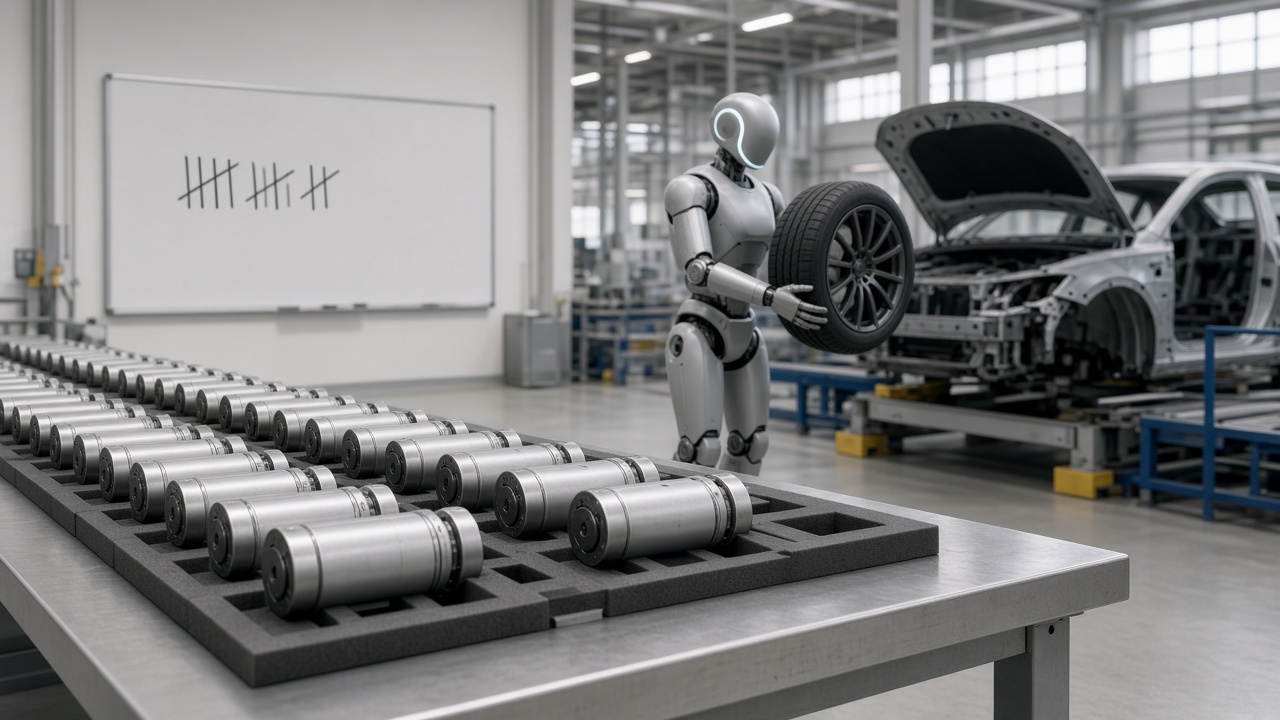
The arithmetic: 30,000 a year is 2,500 a month. Against four a month, that is a gap of about 625x. The parent has written down both the number and the year.
Cost is the second gap. Industry estimates reported by the Korea Herald put Atlas production cost at roughly $130,000 to $140,000 per unit in early mass production, falling to around $30,000 once cumulative production passes 50,000 units. At 30,000 a year, 50,000 cumulative is more than a year and a half of full-rate output. The low number does not arrive until the factory has been running flat out for a while. Boston Dynamics, for its part, says working with Hyundai cut costs 60 to 80 percent from prototype to initial mass production (https://mbiz.heraldcorp.com/article/10889831). That is a company claim. The company added that "even the best product cannot hit target costs without a supply chain and partner ecosystem to back it up." That is a sentence about procurement, and it came from the company best known for robot videos.
Third gap: people. Robert Playter stepped down in February. CFO Amanda McMaster has been interim CEO for nearly nine months (https://www.therobotreport.com/boston-dynamics-appoints-former-amazon-executive-rohit-prasad-new-ceo/). After Playter left, the COO and chief strategy officer left too, and CTO Aaron Saunders went to Google DeepMind, per Semafor. Prasad is the third CEO in the company's history. Marc Raibert ran it from 1992 to 2020.
And the market said what it wanted before Prasad's name came up. When Playter's exit was announced, Hyundai Motor shares rose 5.9 percent in Seoul, and Macquarie analyst James Hong described the outgoing team as "R&D-oriented" (https://www.reuters.com/business/autos-transportation/ceo-boston-dynamics-step-down-hyundais-robot-strategy-focus-2026-02-11/). Hyundai has held a majority stake since 2021. The reaction is easy to read. The parent wanted the lab to become a factory, and the shareholders agreed. Semafor reported the company is working toward an IPO; the Kia CEO told the Korea Herald no decision has been made on timing.
Why an AI person anyway
If the job is a factory ramp, the obvious hire is a manufacturing executive. Hyundai is a carmaker with plants of its own. Jaehoon Chang's quote in the release leans on exactly that: "Hyundai Motor Group's modern manufacturing, logistics, and mobility capabilities." So the production half of the ramp is the parent's job, at least on paper. The half Hyundai cannot supply is the data loop.
Boston Dynamics said this directly to the Herald: "Physical AI is similar to an LLM. The more data you have, the better the robot performs... The problem is that data doesn't exist yet, which is why Atlas needs to get out of the lab." That is the clearest statement of strategy the company has made. The 25,000 internal units are a data collection fleet as much as a labor force.
The infrastructure for that loop is already going up. On September 21 Boston Dynamics opened the Robotics Metaplant Application Center at Hyundai Motor Group Metaplant America outside Savannah (https://bostondynamics.com/news/boston-dynamics-opens-robotics-metaplant-application-center-to-train-humanoid-robots-for-manufacturing-tasks/). Atlas trains there on logistics and sequencing of automotive parts, with component assembly targeted for 2030. Release images show a trainer teleoperating Atlas. Next year operations move into a new building at HMGMA about ten times the current size. The company also said it plans to begin exploring other sectors next year and is in discussions with existing Spot and Stretch customers in manufacturing, aerospace, semiconductors, logistics, food and beverage, and life sciences to scale data collection. In this plan, Spot and Stretch become distribution for an Atlas data program. Zack Jackowski, Chief Product & Technology Officer, said the company has "a clear strategy to optimize our supply chain, production, testing, and deployment capabilities for Atlas."
The hardware is being redesigned around the same loop. The new Atlas hand has four fingers, 13 degrees of freedom, direct actuation, and a single actuator type, designed for mass manufacturing and for high-fidelity simulation so that RL policies transfer from sim to real (https://www.therobotreport.com/boston-dynamics-drops-pinkie-on-new-humanoid-hand/). The previous hand had seven DOF. Dylan Thrush explained the missing pinky: the extra dexterity "is not worth the extra complexity of three additional degrees of freedom, the size, the power consumption, all of the things that come with adding additional actuators." Boston Dynamics says whole-body controllers are trained with RL in simulation, and that wearable demonstrations don't capture high-rate force control. Every one of those decisions trades dexterity for manufacturability and simulatability. That is the trade a company planning 2,500 units a month makes, and a research lab usually doesn't.
This is where Prasad's background fits. Alexa was AI shipped inside a device used in hundreds of millions of households. Nova is a foundation model family used by enterprises. Chang's quote names "Rohit's proven ability to turn AI into products at global scale." Robotics expertise was already in the building. The hire adds someone who has turned models into shipped products before.
The recent product cadence points the same way: Spot 5.2 with agentic workflows, Orbit AIVI now powered by Google Gemini, a $100 million facilities expansion in Waltham, per The Robot Report. The company is already behaving like a platform business. It picked a chief executive who has shipped one.
The actuator line under the whole plan
Strip everything else away and the plan rests on an actuator supply chain.
Actuators account for roughly 60 percent of humanoid material costs, per the Korea Herald. Industry officials estimate each Atlas needs more than 10 of them. Hyundai Mobis is to run a US actuator plant with annual capacity of 350,000 units starting in 2028.
Arithmetic: 25,000 Atlas at more than 10 actuators each is more than 250,000 actuators, less than one year of the planned Mobis output. At the full 30,000 robots a year, more than 10 actuators each is more than 300,000 actuators a year, most of that 350,000 capacity. So the line is sized for Atlas at full rate, with modest room for spares or other products. The single-actuator-type decision on the hand reads differently once you hold this number. Fewer part numbers, higher volume per part, a line that can be planned.
Boston Dynamics named the logic itself: "Scale certainty is one of the key factors in building a successful supply chain." The 25,000 internal order is the scale certainty. Hyundai is handing a group company a guaranteed volume so the actuator can ride down the cost curve before anyone outside the group buys one. The $30,000 industry estimate depends on that line existing and running on time.
Objection docket
"An Alexa executive can't run a hardware company." Alexa was AI built into a physical product, which is the point Gizmodo made while calling him an AI hire. The gap in Prasad's background is production of heavy electromechanical systems, and that is exactly the part Hyundai has said it will supply through the Metaplant and Mobis. Whether the two halves mesh is the open question. It will show up in the build rate before it shows up anywhere else.
"Hyundai is the customer, so the volume is guaranteed." The volume is planned, which is different. Atlas does parts sequencing from 2028 and component assembly only by 2030. If RMAC tasks do not move from a trainer with a teleoperation rig to a robot working a shift on its own, the 2028 date slips and the 30,000 becomes a capacity number rather than a build number. Capacity is what the factory could make. Build is what it does make. Nothing in the released material gives an autonomy rate, and until one shows up, the gap between those two numbers is the whole bet.
"Four a month is old news." Partly true. The figure is from early this year, from former employees, and the company said at the time it was moving from prototype to production. But nobody has published a newer rate. Until a current figure appears, four is the one on record, and 625x is the distance to the target on paper.
What to watch in his first year
One: the monthly Atlas build rate. Four a month is the last figure on record. Any newer number, from the company or from Hyundai's investor materials, tells you more about the hire than his first interview will.
Two: RMAC tasks that leave training. Parts sequencing is the first job. Watch for a task that moves from the training center into the Georgia production line, and for any published success rate or uptime figure that comes with it. Videos of Atlas lifting a tire show the robot can do it once.
Three: the actuator line. The Mobis plant is due in 2028. A site, a groundbreaking, or a slip in that date moves the whole cost curve, because actuators are roughly 60 percent of material cost.
Four: a paying Atlas customer outside Hyundai and Kia. The company is already talking to Spot and Stretch customers about data collection. A signed outside deployment would mean the Atlas program has buyers beyond its parent company.
Prasad said in the release that Boston Dynamics is "uniquely positioned to advance Physical AI through its world-class robotics expertise." Nobody has argued with the expertise. The number that decides his tenure is the monthly Atlas count coming out of Georgia, and he arrives with 2028 already written down.
Sources
- Boston Dynamics, CEO appointment
- The Robot Report, CEO appointment
- Gizmodo, CEO appointment
- Semafor, Boston Dynamics C-suite exodus
- Reuters, Hyundai humanoid deployment plan
- Reuters, Boston Dynamics CEO departure
- The Korea Herald, Hyundai Atlas deployment plan
- The Korea Herald, Boston Dynamics cost and supply chain
- Boston Dynamics, RMAC opening
- The Robot Report, Atlas hand redesign