


2026-10-08 · Ian Lapham
Factories Added 603,307 Robots Last Year. About 7,000 Were Humanoids.
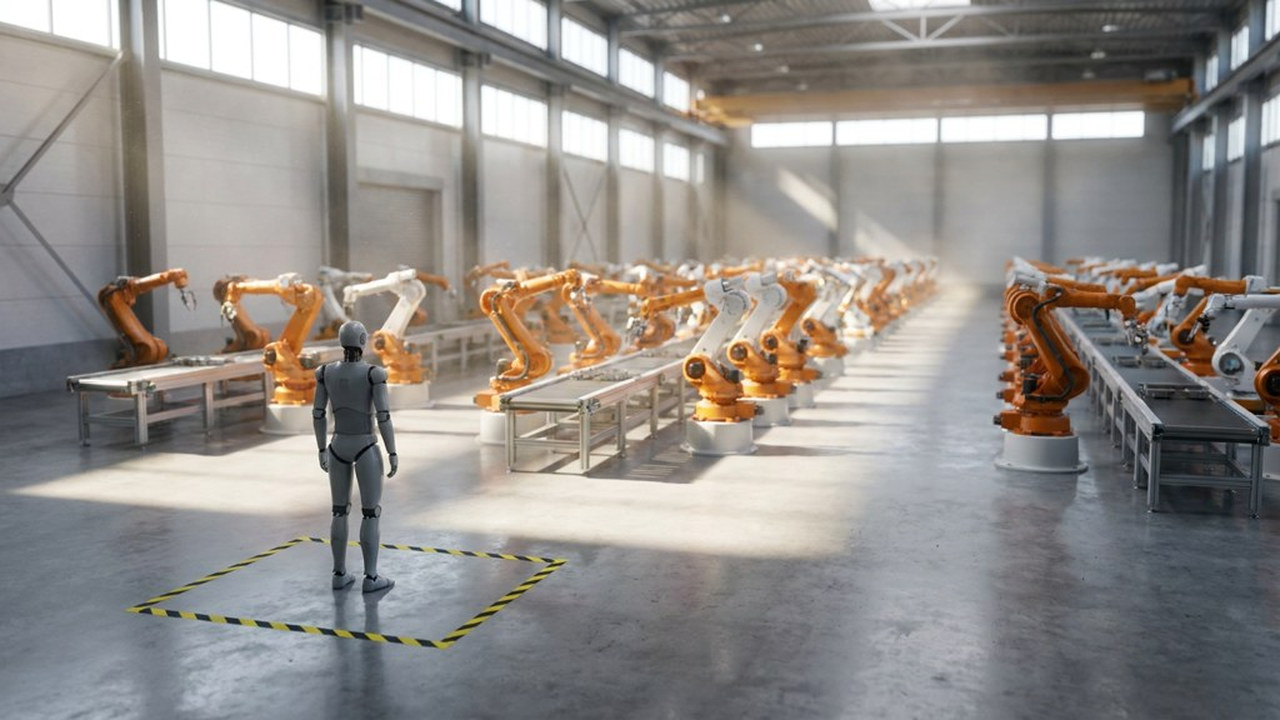
The IFR's 2025 numbers say the robot boom was an arm boom: full-size humanoids were about 1.2 percent of industrial installs and were outsold by surgical robots. And the 7,000 uses a 140 cm, non-research ruler. Swap the ruler and the count roughly doubles.
Factories installed 603,307 industrial robots in 2025, up 11 percent and a record, according to the IFR's World Robotics 2026 report (https://ifr.org/ifr-press-releases/news/five-million-robots-now-operate-in-factories-globally). Nearly 7,000 full-size humanoid robots were sold worldwide in the same year, per the IFR's press conference deck (https://ifr.org/downloads/press_docs/Market_Presentation_WR_Press_Conference_2026.pdf). The prevailing story of 2025 was that it was the year of the humanoid. The numbers say it was the year of the arm: humanoids were about 1.2 percent of industrial installs (arithmetic, 7,000 divided by 603,307).
The 7,000 is small. It is also narrow. IFR counts only robots taller than 140 centimeters sold for commercial or professional use, which excludes the research buyers and the shorter machines that make up most of what the vendor claiming a third of the market actually shipped. Change the ruler and the count roughly doubles. Anyone quoting that number next year needs to know which ruler produced it.
The 2025 scoreboard: arms outsold humanoids 86 to 1
The IFR publishes industrial and service robots in separate reports. The service report, released September 30, carries the humanoid figure alongside logistics, surgical, and consumer categories (https://ifr.org/ifr-press-releases/news/global-sales-of-professional-service-robots-surge-24-percent). Put the two reports together and the table reads like this.
| Category | 2025 units | YoY | Source |
|---|---|---|---|
| Industrial robots installed | 603,307 | +11% | IFR industrial release |
| Collaborative robots (11% of industrial) | ~66,000 (arithmetic) | n/a | IFR press deck |
| Professional service robots | ~250,000 | +24% | IFR service release |
| Transport and logistics service robots | 117,500 (47% of pro service) | +21% | IFR service release |
| Surgical robots | 8,400 | +57% | IFR service release |
| Full-size humanoids (above 140 cm) | ~7,000 | n/a | IFR deck, service release |
| Consumer service robots (different animal, excluded from comparisons) | ~34.2 million | +37% | IFR service release |
The consumer row is there for completeness only. Household robots do not compete with factory arms for budget, and 34.2 million units would swamp any comparison.
The comparisons that do hold start with the ratio in the header: one full-size humanoid for every 86 industrial robots installed (arithmetic). Surgical robots outsold humanoids. Cobots, roughly 66,000, were nine times the humanoid total (arithmetic). Reuters put 2024 industrial installs at around 542,000 (https://www.reuters.com/technology/humanoid-robot-sales-tally-hit-7000-globally-last-year-2026-09-21/), which means arms grew by about 61,000 units in a single year, and that one year of growth alone was close to nine times every full-size humanoid sold in 2025 (arithmetic).
Scale the stock, too. The installed base of industrial robots grew 9 percent to 5,079,078 units, and IFR president Jane Heffner called five million "more than double the number seven years ago." IFR expects the base to pass six million in 2028. Against a base of five million, 7,000 is a rounding error.
The arm boom went to China and metal shops
The headline number has a geography and a customer list, and neither looks like a humanoid pilot.
Asia took 457,315 installs, up 14 percent, or 76 percent of the world. China alone installed 354,226 robots, up 20 percent, which is 59 percent of global installs. Chinese suppliers sold 195,000 units at home, a 55 percent domestic share, down a point from 57 percent in 2024, which means foreign vendors' share of the Chinese market edged up to roughly 45 percent even as that market grew by a fifth (arithmetic).
Europe fell 14 percent to 73,054. The Americas hit a record 57,044, up 14 percent, and within that the United States installed 38,428 robots, up 12 percent, enough to pass Japan and become the second-largest market in the world. Japan dropped 19 percent to 36,219 while Korea slipped 1 percent to about 30,000. Germany fell 8 percent to fewer than 25,000. India grew 15 percent to almost 10,500.
By industry: electrical and electronics 142,235 (up 10 percent), automotive 138,429 (up 10 percent, a new peak), and metal and machinery 108,571, up 22 percent and now 18 percent of all installs. Metal and machinery grew fastest of the three IFR headlines, and it is the least glamorous. The deck adds that demand in general industries has quintupled over a decade. Market value rose 11 percent to $18.6 billion.
The humanoid story runs in parallel to all of this and barely touches it.
IFR's own report calls humanoids pilot-stage
The IFR wrote the thesis down itself.
The executive summary of the industrial report says "General-purpose Physical AI systems and learning from simulation and experience, are not yet industry-grade" (https://ifr.org/img/worldrobotics/Executive_Summary_WR_2026_-_Industrial_Robots.pdf). It continues: "Most humanoids remain prototypes or pilot-stage technologies rather than industrial-grade products. At the current stage of technology, industrial robots are economically superior for industrial production tasks." Widespread deployment, it says, "will depend on substantial improvements in reliability, safety, operating time, and economic viability."
The press deck is blunter. Humanoids "are still on the verge of making the leap from laboratories to pilots," it says, "let alone real deployments." It lists three challenges: safety and functional reliability, lack of training data, and lack of an economically viable business case. The service report adds that "most current applications remain specialized and often require human teleoperation." IFR secretary general Susanne Bieller told Reuters humanoids remain "a fraction" of the robot population.
One concession is owed here. The IFR is far from dismissive. The same deck has a slide titled "Humanoids as Innovation Drivers," calling them "Visible innovation that will spill over to established robot forms." The plausible reading is that humanoid money improves perception and control on arms and mobile robots before humanoids themselves pay off, but the deck does not say that; it says "spill over," and no more. The IFR is counting a new category carefully, and that is as far as its endorsement goes.
The 7,000 is a 140 cm ruler, and a vendor ruler doubles it
Here is the part that will trip up anyone citing the number cold.
IFR's definition has two filters. First, height: full-size means above 140 centimeters. Second, purpose: the robots must be "intended for commercial and professional applications beyond R&D and entertainment." Both filters bite. Bieller, per secondary write-ups of the Reuters piece, said many 2025 humanoids were bought by research institutions or by companies generating AI training data rather than doing productive work. Those units fall outside the count.
Now hold a different ruler. Unitree's Shanghai IPO prospectus, as reported by Rest of World, says the company sold 5,500 humanoid robots in 2025, over 70 percent of them for research and educational purposes, and that Unitree accounted for roughly a third of global humanoid sales (https://restofworld.org/2026/unitree-china-humanoid-robot-shanghai-ipo/). Its G1 has a standing height of 1,320 millimeters (https://www.unitree.com/g1/). That is 132 centimeters, eight short of IFR's cutoff (arithmetic).
Run the arithmetic. If 5,500 is a third of the market, the whole market on Unitree's ruler is near 16,500 units, more than double IFR's 7,000. Only the ruler changed.
Height and buyer type explain much of that gap. The G1 is too short to be full-size, and most Unitree buyers are labs and schools. Whether those two filters explain all of it is unknown, because nothing in IFR's released materials splits the count by height or buyer type, and the two sources count different things in different ways. Treat the 16,500 as a vendor-side count and the 7,000 as a strict professional floor. Which one is right depends on the question you are asking.
One more ratio from the strict count. IFR has identified 174 humanoid manufacturers worldwide, more than half in China, many founded in the last few years. Spread 7,000 units across them and the average maker sold about 40 (arithmetic). The distribution is surely lopsided, but 40 units per company is lab scale.
The counterarguments
The obvious counter is Bank of America's forecast. The 90,000 estimate for 2026, along with 1.2 million by 2030, comes from Bank of America Global Research as cited by Reuters, and reaches us through secondary write-ups of that piece, so hold it loosely. Take it at face value anyway. Ninety thousand would be about 13 times IFR's 2025 humanoid count (arithmetic). It would also be under one-seventh of the 655,000 industrial installs IFR forecasts for 2026 (arithmetic). The IFR forecast adds about 52,000 arms in a single year (arithmetic, 655,000 minus 603,307), several times the entire 2025 humanoid count. Even the bull case is an arm-dominated year.
A second counter points to the first-half 2026 trackers, which already show far more than 7,000. Smart Analytics Global counted about 19,100 and Counterpoint more than 22,000 for the first half of 2026, and we covered the discrepancy between them (https://roboterminal.app/posts/humanoid-shipments-h1). The point stands without re-arguing it: those trackers use form-factor rules that differ from each other and from IFR's 140 centimeter cutoff. A tracker that counts shorter units or research buyers will run above IFR, and that is enough to explain why the published numbers disagree. It is the ruler problem in a different outfit.
A third counter is that this post cherry-picks the pessimistic IFR quotes. The innovation-driver slide is quoted above, and both views can be true. The claim here is about 2025 units, and on units IFR is unambiguous.
Three numbers to check in next year's report
Next year's World Robotics reports will be the test. Three numbers decide whether this post aged well.
First, the IFR humanoid count against the cobot line. Cobots sat near 66,000 in 2025 (arithmetic). If full-size humanoids under IFR's strict ruler clear that in 2026, the arm boom framing needs revision. If they stay under surgical robots, it holds.
Second, whether IFR publishes the gap. A single line splitting out sub-140 centimeter units and research buyers would retire the ruler argument. Its absence means every headline count stays contestable.
Third, industrial installs against IFR's 655,000 forecast. Hitting it means arms add about 52,000 units in one year, more than seven times every full-size humanoid IFR counted for 2025 (arithmetic). A miss would say more about factory capital spending than about humanoids.
Until one of those numbers moves, the honest answer to "how many humanoid robots were sold in 2025" is about 7,000 on the strict ruler, and the honest answer to "what was the robot boom" is 603,307 arms.
Sources
- IFR, five million robots now operate in factories
- IFR, World Robotics 2026 industrial executive summary
- IFR, World Robotics 2026 press conference deck
- IFR, professional service robots surge 24 percent
- Reuters, humanoid robot sales tally
- Rest of World, Unitree Shanghai IPO
- Unitree, G1
- Roboterminal, humanoid shipments H1