


 Leju Robotics
 BMW Group
 UBTech Robotics
2026-10-19 · Ian Lapham
Fifteen Humanoids Are Loading Car Parts at 98%. The Number That Decides Their Future Is 15 Seconds.
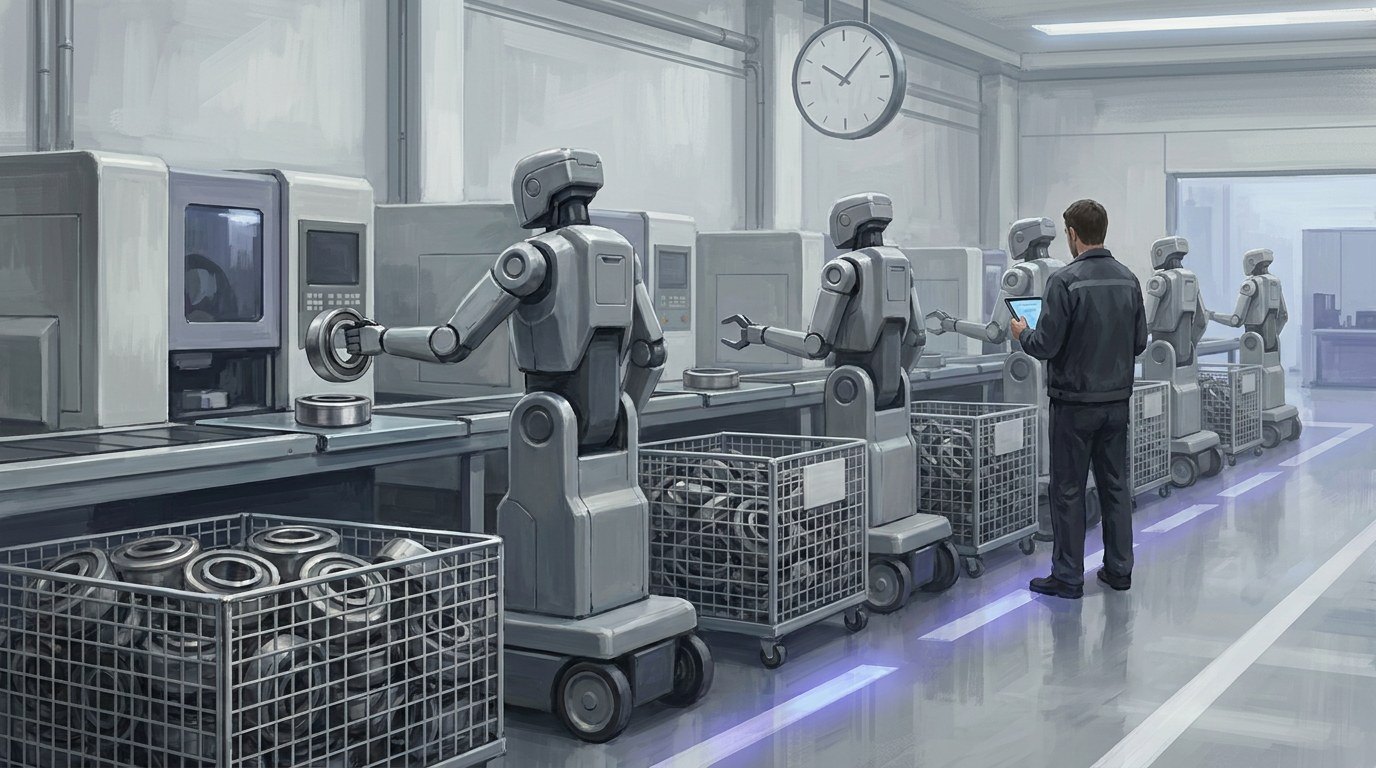
On October 15 Leju Robotics and Zhaofeng said 15 Leju humanoids are in routine operation loading auto parts at a Hangzhou plant: 15 stations, more than 10 part types, a company-reported 98% loading success rate, about 1,000 hours and more than 60,000 parts. Each robot cycle takes 35 to 40 seconds against about 15 for a worker at the same station, and one engineer still looks after roughly four robots. The chairman says he did not start by calculating the cost. The 98% is the lab's number; cycle time, supervision and months of reliability are the factory's.
On October 15, Leju Robotics and Zhejiang Zhaofeng Mechanical & Electrical said 15 Leju humanoid robots are in routine operation loading auto parts at Zhaofeng's No. 3 factory in Xiaoshan, Hangzhou, fitted to 15 stations, covering more than 10 part types, at a company-reported 98% loading success rate, with about 1,000 cumulative operating hours, more than 60,000 parts handled and more than two months on site without a failure (https://www.stcn.com/article/detail/4221295.html). A robot loading cycle runs within about 40 seconds, a human worker at the same station takes about 15 seconds, and the factory still needs one engineer to look after roughly every four robots (https://www.21jingji.com/article/20261019/herald/2229f5247cdf19d8b44ef342437c3e38.html).
A Securities Times reporter watched the line on October 15. 21st Century Business Herald visited and published on October 19. The operating figures come from Zhaofeng and Leju; nobody has audited them (https://robotsbeat.com/leju-zhaofeng-15-humanoid-robots-auto-parts-loading/). Quotes from both papers are in Chinese and the English here is our translation. Industrial AI Dispatch notes a Jiemian reporter also observed the line and corroborated the stations, parts and cycle time (https://www.industrialaidispatch.com/edition/2026-10-17).
Our view: 98% is the lab's number. A factory keeps score on cycle time, on how many humans stand behind the robots, and on how many months the line runs without stopping, and on those three the disclosed figures describe a paid-for training site, not yet a production replacement. Zhaofeng chairman Kong Aixiang said, in our translation, that the company did not initially calculate the procurement cost and that the first goal was to get the application working. The paper reports a payback period that "may be three years" at some future point, after efficiency gains and upgrades. That is an honest description of a pilot. The number that decides whether this becomes a product is 15 seconds, and the plant has given itself six months to a year to get there.
The job is bearings from wire bins to a preset position
The task is narrow and the papers describe it consistently. Parts come out of wire-mesh bins and go to preset positions at a machining station, and wheel-hub bearings are among them (https://robot24.com/15-humanoid-robots-are-being-put-to-work-at-a-chinese-auto-parts-factory). Securities Times says the robots grasp small parts with inner diameters of 80 to 120 mm and complete more than 10 action sequences across multiple stations and loading tables. Its reporter watched one robot "slowly bend down, grab a wheel-hub bearing, slowly turn, and gently place it" for the next process. The 21st Century reporter describes a wheeled robot using a gripper to pick a part and set it on the line. When the reporter moved parts around in the bin, the robot re-identified and grasped them.
That last detail is the year's work. Early on, the robots worked when part positions were fixed; if a worker changed the placement, the robot might not find the target. Repeated data collection and algorithm tuning fixed it. The robot also has to connect to Zhaofeng's MES, receive feeding tasks and coordinate with the processes upstream and downstream. Station space, equipment status and even the direction of light had to be designed in.
Ke Zhendong, Leju's executive VP, drew the lab-to-factory line himself. In a clean, controlled lab the team might lift a task's success rate to 98% within a month. In the real plant, part sizes vary, scratches change reflections, oil affects recognition and grasping, workers stack parts in different habits, and natural light shifts through the day. Many problems only appeared after deployment. Over nearly a year the joint team kept training, adding data and testing, and sometimes had to scrap a model and retrain. Progress came in stages, not daily. The 98% took a year on the factory floor, not a month in the lab.
Leju's tooling claims sit behind that. Its R&D side says a skill toolchain splits loading into more than 30 basic modules combined "like building blocks" without low-level code, cutting development from months to weeks, and a scheduling platform pushes a standard skill to many units, cutting deployment from days to hours (Securities Times). Those are vendor claims about the next plant. The first plant took a year.
A plant that already owns arms bought mobility, not reach
Zhaofeng is not new to automation. It began around 2013 with robot arms and automation equipment, at large investment (21st Century). Arms are the standard answer for fixed point-to-point feeding, and they fall short when lines change or parts move. Zhaofeng says it wants mobility and task switching across processes in future.
The commercial pressure is batch size. General manager Kong Chenhuan told the paper that some overseas orders are small-batch, many-variety, with minimum orders of only 250 or 300 sets. Highly automated lines suit large single-variety runs; frequent changeovers raise scheduling, tooling and calibration demands. His example: after a model switch, even with tooling changed, multiple stations need point confirmation and equipment calibration, usually three engineers for two to three hours. That is 6 to 9 engineer-hours per switch (arithmetic). If robots could do it before shift start, the line could start earlier. He also said the main task for now is still loading and cross-process value is still being explored.
Labor is the other half. Repetitive, physically demanding jobs are hard to fill with young people even though operator wages are not low. Kong Aixiang framed the entry condition this way: "Robots entering a factory need the factory's existing technical and digital foundation. Just as people are electricians, mechanics, operators, inspectors, robots entering the workshop must first divide scenes and tasks clearly and achieve them one by one." He called pursuing general AI at this stage "not realistic."
So the stated reason for a humanoid in a plant full of arms is that it can move between stations and switch tasks as batches change. Today the robots only load. The changeover job is an idea, not a deployment.
Three numbers the 98% leaves out
The first is cycle time. 21st Century puts robot loading time at about 35 seconds and the full cycle within 40 seconds; Securities Times says a worker at the same station takes about 15 seconds. That makes the robot roughly 2.3 to 2.7 times slower (arithmetic), with RobotsBeat's caveat that the comparison depends on part and station. Kong Aixiang's target is to compress loading to about 15 seconds within six months to a year, by cutting redundant motions and adding training. From October 2026 that lands between April and October 2027 (arithmetic).
The second is supervision. One engineer per roughly four robots means about four engineers for 15 robots (15/4 = 3.75) (arithmetic). Set that against output. At 35 seconds per load, 15 robots deliver about 6.4 workers' worth of loading pace; at 40 seconds, about 5.6 (arithmetic). Call it six workers' pace, if the station-for-station comparison holds. It may not: the papers give one same-station worker figure and do not break it out across all 15 stations or 10-plus part types. On the disclosed numbers, four engineers are tending machines that load at the pace of roughly six people. Industrial AI Dispatch lists what has not been published: intervention frequency, shift availability, safety stoppages, maintenance cost, cost per part.
The third is reliability over time. Kong Aixiang said the robots can now run 8-hour operations, but a day, a month, ten months and a year of continuous use are different things, and the one-year validation period is mainly about reliability. The "more than two months without failure" figure is company-reported and sits inside that window.
One more number does not resolve. More than 60,000 parts over about 1,000 hours is 60 parts per operating hour if the 1,000 hours is a project total (arithmetic). RobotsBeat reads both as project figures, not per-robot totals. A single robot at 35 to 40 seconds per cycle would complete about 90 to 103 cycles an hour (arithmetic), so 1,000 hours cannot be the sum of all 15 robots running at full pace. The companies have not broken the figures out by robot or shift, and until they do the ratio says little about utilization.
Scoreboard: Hangzhou versus Spartanburg
The nearest public comparison is Figure 02 at BMW Group Plant Spartanburg. Figure says an 11-month deployment loaded more than 90,000 sheet-metal parts onto a welding fixture over 1,250-plus hours of runtime, on a 10-hour shift Monday to Friday, and contributed to more than 30,000 X3 vehicles (https://www.figure.ai/news/production-at-bmw). Its KPIs were an 84-second total cycle with a 37-second load time, placement accuracy above 99% per shift, and zero interventions per shift. Repairer Driven News observed that "the release does not share data on how well the humanoids performed in meeting those goals" (https://www.repairerdrivennews.com/2025/11/25/humanoid-robots-complete-11-month-project-at-bmw-plant/).
| Leju + Zhaofeng, Hangzhou | Figure 02 + BMW, Spartanburg | |
|---|---|---|
| Task | Load small auto parts (80-120 mm ID, incl. wheel-hub bearings) from wire bins to preset positions | Load sheet metal onto a welding fixture |
| Fleet size | 15 robots | Not stated in the figures cited here |
| Customer relationship | JV partner since Oct 27 2025; JV runs robot-training operations | BMW is a customer |
| Duration disclosed | ~1 year of joint work; >2 months without failure | 11 months; full line deployment within 10 months |
| Runtime hours | ~1,000 (project total, company) | 1,250+ |
| Parts | >60,000 (company) | 90,000+ |
| Cycle time | ~35 s load, <40 s full cycle; worker ~15 s at same station | Spec: 37 s load, 84 s cycle; achieved not disclosed |
| Success metric | 98% loading success (company) | Target >99% per shift; achieved not disclosed |
| Interventions | ~1 engineer per 4 robots on site | Goal zero per shift; achieved not disclosed |
| Hardware failure disclosure | None reported in >2 months (company) | Forearm was top failure point; Figure 03 re-architected wrist electronics |
| Data output | >40,000 records/month; dataset donated to OpenAtom's OpenLET | Fed into Figure 03 design |
Two rows carry the argument. The interventions row shows Leju disclosing a live staffing ratio where Figure disclosed only a goal. The cycle row shows Leju publishing the human comparison at the same station, which Figure did not. Credit both. A company that tells you its robot is 2.3 to 2.7 times slower than the worker beside it has handed you the metric to hold it against. Figure's 37-second load spec sits between Leju's 35-second loading time and its sub-40-second cycle, but the parts and tasks differ and this is not a like-for-like race. Figure's parts per runtime hour work out to about 72 (arithmetic); Leju's cannot be computed cleanly for the reasons above. BMW says Figure 03 will start at Spartanburg on sequencing in logistics after the Figure 02 run (https://www.press.bmwgroup.com/global/article/attachment/T0458778EN/651496), so the next data from both sites will be on new tasks.
We argued that a robot count is the right scoreboard for a humanoid maker when Boston Dynamics changed CEOs (https://roboterminal.app/posts/boston-dynamics-prasad-robot-count). For a factory buyer it is only the first line. Fifteen is a real count. On its own it says little about throughput.
Objection docket
"The customer is a JV partner, so this is not a real sale." Partly true. The two companies set up the joint venture on October 27 2025, and the JV handles robot-training operations (Securities Times). The chairman said cost was not calculated first. That is why we call it a paid-for training site rather than a customer win. The path Zhaofeng describes, proof of concept, then small-batch orders, then replication, puts the sale at step two.
"98% is good enough for a loading job." For a single pick, maybe. RobotsBeat's point stands: the metric measures something different from uptime or productivity, and there is no disclosure of recovery time after a failed attempt, intervention frequency, or the share of a shift spent on useful work. Two failures in a hundred picks could cost seconds or minutes each. The companies have not said which.
"The data is the real product." Leju says the 15 robots collect 800 to 1,200 records a day depending on production, more than 40,000 a month at the current rate, with failures, drops and position errors kept and classified for training (21st Century). Twelve hundred a day for 30 days is 36,000 (arithmetic); the 40,000 is the companies' estimate. The OpenLET donation is real. But an industry person told 21st Century that open data helps demos and research and is not enough for other makers to train their own robots and deploy in factories, because bodies, process requirements and deployment conditions differ. On that reading the data's value accrues mostly to Leju. For Zhaofeng it is a byproduct of a line that still runs slower than its people.
"A wheeled robot with a gripper is not a humanoid, and an arm would do this." The plant already has arms. The reason given for something else is mobility and task switching across stations for small batches. That case is unproven at this site, because so far the job is loading and the cross-process work is an idea. We will not describe the form beyond what a reporter saw: a wheeled robot and a gripper. Whether it earns its place over a mobile arm is a question the changeover task would answer, and nobody has run it.
For scale, UBTech and FAW-Volkswagen said on October 15 they will develop and test humanoids for logistics, without a robot count, value, timeline or site (https://theaiinsider.tech/2026/10/15/china-physical-ai-roundup-ubtech-signs-faw-volkswagen-cd-deals-and-ldrobot-moves-to-buy-germanys-sabo-plus-funding-rounds/). Against that, Leju and Zhaofeng's disclosure is unusually specific, which is why it can be argued with.
Three things to check
- Loading time against the 15-second target between April and October 2027. Kong Aixiang set six months to a year from October 2026 (arithmetic). A disclosed drop from 35 seconds toward 20 would show the redundant-motion cuts and retraining are working; a repeat of 35 would mean the gap to the worker has not closed.
- The engineer-to-robot ratio and intervention counts per shift. One to four is a rare live supervision number for a humanoid factory deployment. Industrial AI Dispatch's list is the right one: availability by shift, interventions per 1,000 cycles, safety stops, maintenance hours, scrap and misload rates, cost per accepted part.
- A second auto-parts plant, outside the joint venture, paying for the same loading solution. Ke Zhendong said the current solution has some adaptability and that migrating to similar auto-parts plants could win customer acceptance. Leju's stated next step is to get more factories to pay. A non-JV buyer at a disclosed price would be the first sale.
The chairman has said he is willing to wait for 15 seconds. The rest of the industry should watch that number, not the 98.
Sources
- Securities Times, Leju humanoids at Zhaofeng
- 21st Century Business Herald, Zhaofeng plant visit
- RobotsBeat, Leju and Zhaofeng auto-parts loading
- Industrial AI Dispatch, October 17 edition
- Robot24, 15 humanoids at a Chinese auto-parts factory
- Figure, production at BMW
- Repairer Driven News, humanoids finish BMW plant project
- BMW Group, Spartanburg humanoid project
- The AI Insider, China physical AI roundup