


2026-09-13 · Ian Lapham
Halos Is Not a Feature. It Is the Safety Landlord.
NVIDIA’s Halos for Robotics, restated on 12 September 2026, puts IGX Thor, Halos OS, and an inspection lab under one roof. Agility’s Digit is first in. The stack is the product.
The demo era of humanoids is ending on the same floor where industrial buyers already buy arms: a warehouse with people in it. The missing piece has not been another gait clip. It has been a safety architecture someone other than the OEM will underwrite.
On 12 September 2026, GCN restated NVIDIA’s Halos for Robotics pitch — first announced at Automate 2026 in Chicago on 22 June — as a full-stack safety system for robots and physical AI that unifies AI compute and safety. The claim NVIDIA wants in the record is blunt: industry’s first full-stack, open robotics safety system purpose-built for machines that sense, decide, and act next to people.
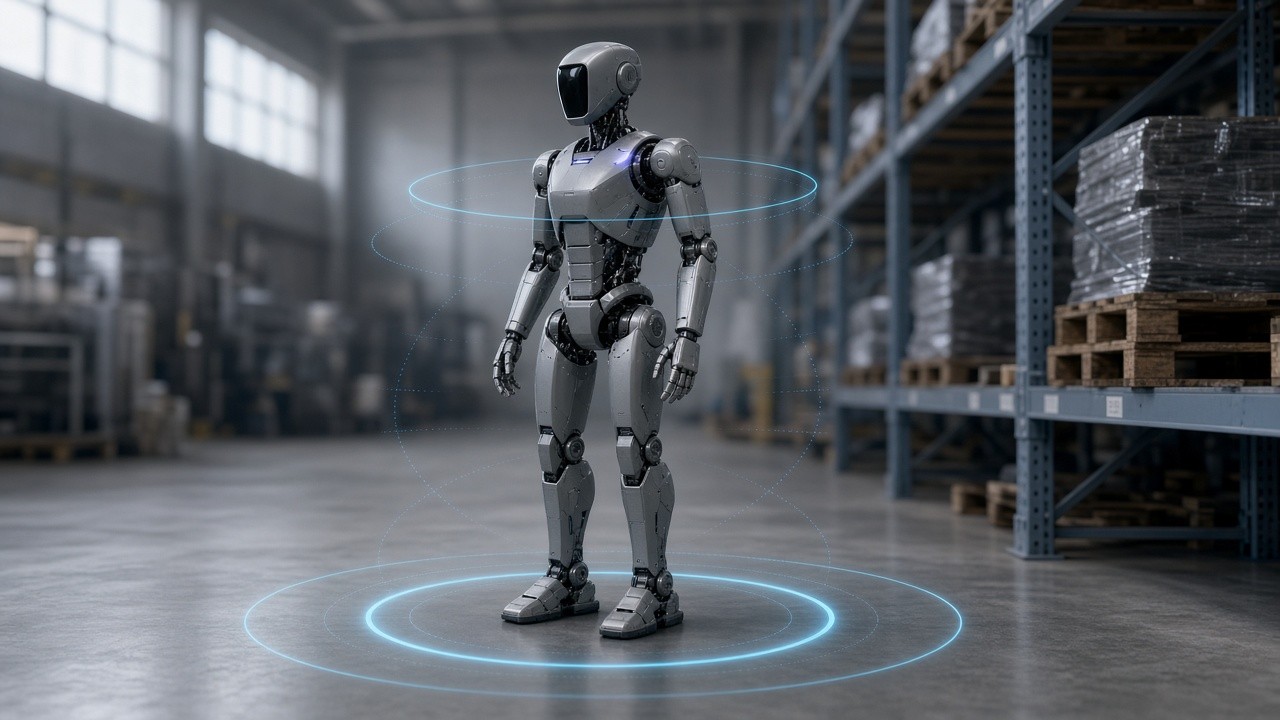
What is in the stack
GCN’s restatement lists the pieces NVIDIA is selling as one system:
| Layer | What NVIDIA names | Role |
|---|---|---|
| Compute | NVIDIA IGX Thor | Industrial AI compute for the robot |
| Sensors | Holoscan Sensor Bridge | Sensor path into the stack |
| System software | Halos OS / Halos Core | Safety runtime |
| Validation | Halos AI Systems Inspection Lab | Pre-assessed path toward third-party certification |
NVIDIA also points at more than 18,600 engineering years of safety work from autonomous driving as the pedigree for the robotics stack. Treat that as company framing, not an independent audit.
Developer access, per the same write-up: Halos Core for IGX is in early access for registered developers (Linux and Linux plus QNX). An open-source Halos Outside-In Safety Blueprint sits in early access on GitHub under the Halos Applications layer.
Digit is the first named adopter
Agility Robotics is the first company GCN names as using Halos to build safety into humanoids already working in factories, warehouses, and logistics. The customer list attached to Digit in that piece: Amazon, GXO, Schaeffler, and Toyota Motor Manufacturing Canada.
Agility’s plan, as restated: integrate NVIDIA IGX Thor and Halos Core into Digit’s existing human-detection and safety systems, and join NVIDIA’s inspection program against standards including IEC 61508, ISO 13849, and ISO/IEC TR 5469 before final third-party certification.
CEO Peggy Johnson, quoted in the same article: “For humanoids to deliver value at scale, safety has to be built into the robot and validated across the entire system.” That is the buyer sentence. It is also the landlord sentence.
The ecosystem claim is wider than Agility. GCN says more than 43 companies have joined the Halos ecosystem, naming partners that include Agility, Boston Dynamics, and Hesai.
Why this desk cares now
North American robot orders are not theoretical backdrop. The Association for Advancing Automation figures restated by GCN: 8,940 robots ordered in Q2 2026 valued at $622 million; first-half 2026 totals 17,995 units valued at $1.166 billion. Non-automotive customers were 56 percent of second-quarter orders — the same buyer class most likely to put a humanoid beside a person.
Safety is becoming a platform purchase. Halos is NVIDIA’s attempt to be the common benchmark insurers, operators, and regulators can point at, the way crash ratings became a shared language for cars. That is valuable. It is also concentration: compute, sensors, OS, and inspection under one vendor.
What this is not
This post is not a Digit certification. Agility is still in NVIDIA’s inspection program before final third-party certification. IEC 61508 and ISO 13849 names on a roadmap are not stamps on a plate.
This post is not proof Halos is the only viable stack. It is proof NVIDIA wants the safety layer to travel with the silicon the way LeRobot now travels with a landlord.
We have not audited the Halos Outside-In Safety Blueprint on GitHub for this note. Early access is a status, not a field result.
The chain, two hops
Peer. Anyone shipping a warehouse humanoid into a mixed workforce — Agility Digit first, then the rest of the Halos partner list including Boston Dynamics. They buy a common inspection language and accept a common dependency.
Up. IGX Thor, Holoscan Sensor Bridge, Halos OS, and the Inspection Lab. NVIDIA’s autonomous-driving safety org is the claimed upstream talent pool.
Down. Amazon, GXO, Schaeffler, Toyota Motor Manufacturing Canada as named Digit customers in the GCN restatement — the floors where human-detection has to be boringly reliable before volume.
Sources for this desk
Primary restatement: Hugo Rojas, GCN, 12 September 2026, “NVIDIA launches Halos for Robotics…”. Automate 2026 date and A3 order numbers are taken from that piece as restated, not independently re-pulled for this note.