


 World Labs
2026-09-04 · Ian Lapham
Two Atlases: One Walks, One Builds the Room It Walks In
World Labs' new world model cuts the cost of scanning a real space by roughly two orders of magnitude. That is a supply-chain story for humanoids, not a competitor to them.
There are two things called Atlas in robotics right now, and they have nothing in common but the name. Boston Dynamics Atlas is a humanoid robot: a torso, two legs, a battery, and a factory contract. World Labs Atlas, released into early access on September 1, is software: a model that takes a handful of photos of a real place and produces a 3D scene a robot can be trained in. This piece is about the second one. The only reason to mention the first is that people searching for either will land on the other, and because the software is, in a loose but real sense, a supplier to the robot.
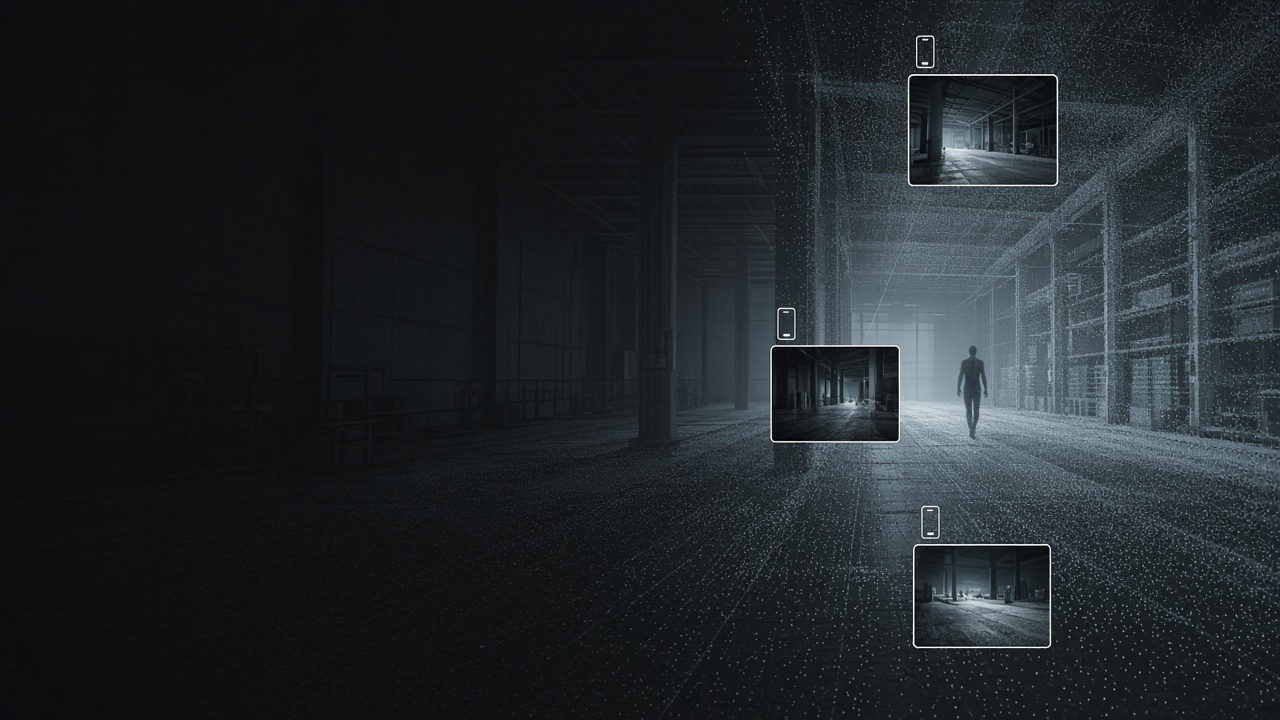
A world model, in the sense World Labs uses the phrase, is a model that generates, reconstructs, and simulates a place: how it looks from a new angle, where the walls actually are, what a camera moving through it would record. Atlas is World Labs' second-generation version of that idea. The claim I want to defend is narrow. Atlas matters to robotics mainly as a cost collapse in one line item, the capture of real environments, and most of the excitement around it (the one-minute 1440p videos, the bullet-time shots from three phones) is a side effect of that same collapse.
The mechanism is what World Labs calls a spatial context. Like an LLM, Atlas encodes inputs into a context and generates conditioned on it. Unlike an LLM, every image in that context is pinned to a 3D position. The model was pretrained from scratch on text, images, video, and 3D together, as one multimodal autoregressive diffusion transformer, so the pixels it generates and the depth it estimates come out of the same representation. That single design choice is why it can output a point cloud or a Gaussian splat and also render what a robot's chest camera would see while walking through that splat.
The two Atlases share a name and nothing else
To spell out the disambiguation once, so it does not need repeating. In April 2024 Boston Dynamics retired its hydraulic Atlas and showed an all-electric successor built for industrial material handling, with joints that rotate past human range of motion and a stated target of dull, dirty, and dangerous work in factories. It is a machine that lifts things.
World Labs is the company Fei-Fei Li co-founded in 2024 alongside Justin Johnson and Ben Mildenhall. It shipped its first product, Marble, in November 2025, and Atlas is the model that will power Marble's next versions. It has no body, no actuators, and no customer in a warehouse.
The relationship between the two is upstream-to-downstream, not rival-to-rival. World Labs Atlas is the kind of tool an integrator would use to build the simulated warehouse that a Boston Dynamics Atlas, or an Agility Digit, or a Figure, gets rehearsed in before it touches a live pallet.
World Labs sells cheaper rooms, not smarter robots
Start with the old cost. To reconstruct a room well enough for simulation, you needed a dense capture: a LiDAR rig or a photogrammetry pass of a hundred to three hundred photos, then hours of cleanup. In the a16z conversation about the launch, the founders put the reduction at 50 to 100x, from hundreds of photos down to three. The blog is more careful. Atlas gives faithful reconstructions from two or three images, and it can also take over a hundred into its context when you want fidelity rather than imagination. The company's own line for this tradeoff is a good one: the more it sees, the less it imagines.
The robotics demo makes the cost story concrete. World Labs scanned two large environments with a cell phone video, used 24 frames from each for reconstruction, then simulated several robot morphologies moving along different paths and generated RGB and depth from the robots' body-mounted cameras. The world and the robot's view of the world come out of one model. No survey crew, no dedicated capture hardware, no separate renderer sitting between the scan and the policy.
The unit World Labs is driving toward zero is the cost per training environment. Everything else about Atlas, including the cinematic reframing and the text-to-360 panoramas, is the same capability pointed at a different customer.
The bottleneck it attacks is scene count, not chip count
Robot foundation models are starved for environments in a way language models never were for text. Agility's Digit, one of the most deployed humanoids in the West, has logged roughly 65,000 hours across nine customer sites. That is a real fleet. It is also nine buildings. A policy trained on nine floor plans has seen nine ways a conveyor can be bolted to a wall.
Simulation is the standard answer, and the standard problem with simulation is that someone has to build the scenes. Hand-modeled environments cost weeks of artist time each. Procedural generators produce variety but drift from how real facilities are actually cluttered. Real-to-sim tries to split the difference by scanning actual sites, which is exactly the step that has been too expensive to do at scale.
World Labs' bet, laid out in its real-to-sim-to-real post and in the SceniX acquisition, is that the scan is now cheap enough to do for every site an operator cares about, and for many they do not. A phone walk-through of a customer's dock becomes a splat, the splat becomes a scene a simulated robot can move through, and the policy trains against sensor views generated from that scene. Whether the resulting policies transfer back to the real dock is still the open question in the field. I'd put more weight on the depth output than on the pretty video. A point cloud you can validate against a tape measure; a render you can only admire.
The honest objection: imagined geometry is a safety problem
Here is the argument an integrator should make. Atlas fills in regions no camera saw. In the blog's own cottage example, a single photo yields a plausible but invented house next door, and it takes three photos before the whole scene is real. A robot trained on invented walls, or on a splat whose floor is off by four centimeters, has learned something false about a place where a person is going to stand.
The objection holds, and World Labs partially answers it in two ways. First, the density knob. Twenty-four frames from a phone video is a very different regime from one snapshot, and the reconstruction numbers the company reports (it claims to beat specialist 3D reconstruction models on standard depth-estimation and camera-pose benchmarks) are for the well-covered case, not the one-photo case. An integrator controls how much the model is allowed to imagine by controlling how much it is shown. Second, the output is explicit geometry, not just pixels. A point cloud or a splat can be checked against a laser measure, a floor plan, or a second scan. That is a real advantage over video-only world models, where a wrong wall is indistinguishable from a right one until a robot walks into it.
What it does not answer: World Labs has published no sim-to-real transfer result. The demo shows simulated robots moving through reconstructed scenes and cameras rendering plausible views. It does not show a policy trained in those scenes running on a real floor and being measured. Until that number exists, the cost collapse is proven and the payoff is inferred.
Decision tests
For an integrator deciding whether to try it: scan one site you have already captured the expensive way. Compare capture hours, cleanup hours, and measured geometric error at ten reference points. If the error is inside your tolerance and the hours drop by an order of magnitude, the cost story is real for you. If the error is outside tolerance, add frames until it isn't, and see whether the cost story survives.
For a humanoid maker deciding whether cheap scenes help: hold out one customer site, train with and without a batch of Atlas-reconstructed environments, and measure on the held-out site. If scene count is the bottleneck this piece claims, the gap should show up there. If it does not, the bottleneck is somewhere else and cheaper rooms will not fix it.
For a reader deciding how much to believe: wait for a real-to-sim-to-real result with a number attached. Videos of robots walking through splats are demos. A success rate on a real dock, before and after, is evidence.
The memory test
If you keep one sentence: World Labs Atlas builds rooms; Boston Dynamics Atlas walks in them. The first is a cost cut on training environments, not a robot, and its value to robotics will be decided by whether policies trained in cheap rooms hold up in expensive ones.