


 XPENG
2026-09-09 · Ian Lapham
XPENG Put Car-Plant QC on a Humanoid Line
The first next-gen IRON walked off a Guangzhou line XPENG says runs above 80 percent core-process automation under automotive-grade consistency standards. Here is what that proves about the body, what it borrows from the EV supply chain, and what it leaves untested.
Humanoid news has a shape by now. A robot walks across a stage under good lighting. Someone online decides there is a person inside the suit. A week or two later a funding round closes with a valuation attached, and the valuation becomes the story. The clip does the work. Nobody asks what happened to the robot after it left the stage.
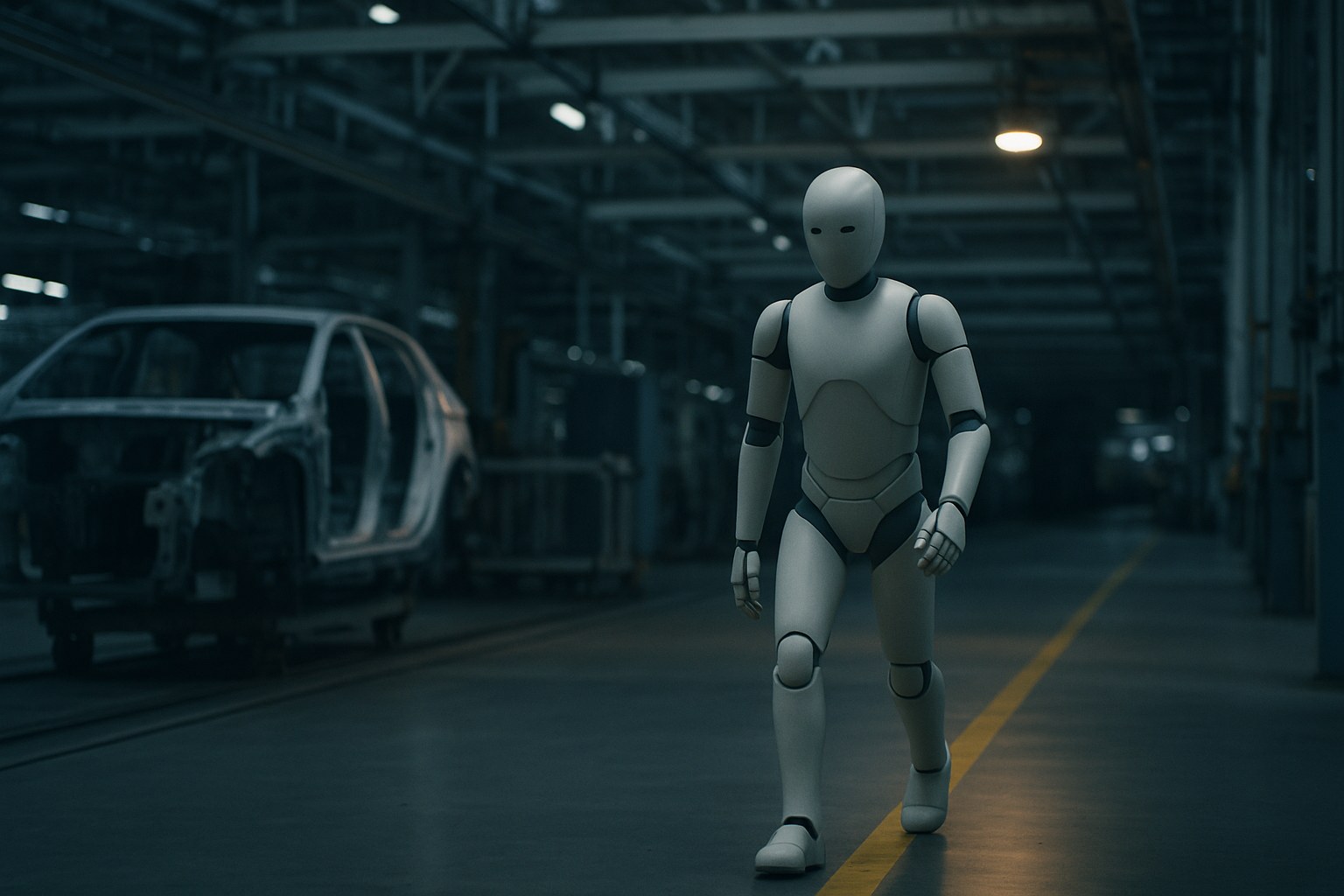
XPENG released a clip this week too, which is why the more interesting fact is easy to miss. On September 7 in Guangzhou the company commissioned production lines for its IRON humanoid, lines it says run with core-process automation above 80 percent, and the first next-generation unit completed automated final assembly and then walked off the end of the line on its own power (https://www.prnewswire.com/news-releases/iron-the-worlds-first-advanced-general-purpose-humanoid-robot-walks-off-the-production-lines-as-xpengs-humanoid-robot-manufacturing-facility-is-officially-commissioned-302871836.html). The walk is what circulates. The line is what XPENG actually built.
Here is the claim. The scarce asset in humanoids in 2026 is a process that produces consistent units, and XPENG's bet is that the quality system it already runs for electric cars transfers onto a biped with 76 degrees of freedom. Anyone with enough capital can get one robot to walk well. Getting the two hundredth unit to walk exactly like the first is a factory problem, and factory problems are where car companies have a real edge over labs. Whether that edge survives contact with a product that has 42 finger joints is the open question for the next fifteen months.
The walk that mattered was off a line
The Chinese-language announcement, dated September 9, describes the lines as built from scratch for a product category that did not exist as a manufactured good (https://www.xiaopeng.com/news/company_news/5592.html). He Xiaopeng put it plainly: the production lines were created with no precedent to follow, today's step is small, and the company is building the lines for an entirely new category. He also said XPENG will explore faster cycle times and greater scale from here, which is the honest way to say the current rate is not the target rate.
The ceremony had theater in it. He clipped a staff badge onto IRON after it reached the end of the line, and the framing was that the robot had joined the team. Fine. Every plant opening has a ribbon. What matters underneath the ribbon is the sequence the company chose to show: automated final assembly, then a functional walk out of the cell with no human assistance and no remote control for that segment, according to XPENG. That order is deliberate. In a car plant the last station before the yard is a dynamic test where the finished vehicle drives under its own power and gets checked against a spec. XPENG staged the humanoid equivalent and made the robot's first walk the end-of-line gate rather than a marketing shoot.
The company calls these the world's first automated production lines for advanced general-purpose humanoids. That is XPENG's framing and should be read as such. Other humanoid builders have shown pilot cells and hand assembly, and none that I know of has publicly documented an automated final assembly line with a walk-off gate at this level of detail, but absence of disclosure is a weak basis for a superlative. Report it as a claim and move on to the parts that can be checked.
Coverage from Electrek (https://electrek.co/2026/09/07/xpeng-iron-humanoid-robot-production-line/), CleanTechnica (https://cleantechnica.com/2026/09/08/xpeng-iron-autonomously-walks-off-production-line/), Gasgoo (https://autonews.gasgoo.com/articles/icv/xpeng-robot-production-line-officially-activated-2097590293821218817) and Digital Trends (https://www.digitaltrends.com/cool-tech/xpeng-just-put-its-humanoid-robot-on-the-production-line-and-it-walked-itself-out/) all lead with the walk. Reasonable. It is the visual. But the 80 percent figure is the load-bearing number in the release, and it deserves more scrutiny than the gait.
What "automotive-grade" means when the product has 76 degrees of freedom
The phrase XPENG uses in Chinese is 车规级一致性标准, automotive-grade consistency standards, and the release says the company is fusing the mature quality system of the auto industry with precision humanoid manufacturing to build a mass-production quality system for high-end humanoids. Strip the marketing and the meaning is specific. Automotive quality is about variation control. Every torque on every fastener is recorded and traceable to a tool and a timestamp. Incoming parts arrive with capability data from the supplier. In-process inspection catches drift before it reaches the next station. The end-of-line test exists to catch what everything upstream missed, and the target is that it catches almost nothing because the process itself is in control.
Transfer that onto IRON. The next-generation body has 76 degrees of freedom, with 21 in each hand (https://www.prnewswire.com/news-releases/iron-the-worlds-first-advanced-general-purpose-humanoid-robot-walks-off-the-production-lines-as-xpengs-humanoid-robot-manufacturing-facility-is-officially-commissioned-302871836.html). Each degree of freedom is an actuator, a reduction stage, position sensing, a harness run, a thermal path, and a mounting interface with its own tolerance stack. A car has a few dozen actuators that matter to the customer, and most of them tolerate a sloppy fit because a window regulator does not have to coordinate with the steering column in real time. A humanoid gait is a closed-loop coordination problem across dozens of joints at once. Backlash in one hip that differs from the hip on the unit next to it changes how the controller has to compensate. Build twenty units by hand and you get twenty slightly different robots that each need tuning. Build twenty on a line under statistical control and you get a fleet the same firmware can run without per-unit babysitting.
That is the actual reason a car plant approach is interesting here. The gait video proves the controller works on one body. The line is a claim about the distribution of bodies. Consistency is what lets software scale across hardware, and software scaling across hardware is the entire economic argument for a general-purpose humanoid.
A few things the 80 percent figure does not tell you. It covers core processes, by XPENG's own wording, which means the labor content of the full build is higher than 20 percent. Routing harnesses through a limb, seating the proprietary flexible lattice structure that gives IRON its enclosed, human-like shell, dressing the soft mesh under fabric that CleanTechnica describes, tuning a 21-joint hand: these are exactly the operations that resist automation in cars too, and cars do not have hands. Automation of the core processes is a real achievement if the number holds. It is also the easy 80 percent.
The shared bill of materials
CleanTechnica reports XPENG's claim that more than 85 percent of the humanoid supply chain is shared with the company's EV business, with cost and quality synergies as the stated benefit (https://cleantechnica.com/2026/09/08/xpeng-iron-autonomously-walks-off-production-line/). That figure is not in the English press release I could find, so treat it as a reported company claim rather than a documented spec. The release does not say whether 85 percent is measured by supplier count, part count, or value, and those three denominators produce very different pictures.
Still, the direction is plausible and it is the strongest structural argument in XPENG's favor. Start with compute. IRON carries three of XPENG's Turing chips for up to 2,250 TOPS of effective compute, running the company's physical AI foundation model on-device, with the stated aim of completing complex tasks without teleoperation and keeping inference latency and data on the robot (PR Newswire link above). Turing is the same silicon family XPENG developed for its cars. A chip that has already been through automotive qualification, with a supplier that already delivers it to a vehicle line, is a very different procurement problem from a dev board sourced for a lab prototype.
Extend the list. Battery cells and pack electronics, power distribution, motor drives and inverters, cameras and their calibration fixtures, connectors, harness suppliers, plastics and soft trim. All of this exists in an EV bill of materials with qualified vendors, agreed inspection plans, and volume pricing. Anyone who has tried to source a humanoid from robotics-specialty vendors knows the alternative: small suppliers, long lead times, part-to-part variation that the customer has to absorb.
The parts that almost certainly are not shared are the ones that make a humanoid a humanoid. Compact high-torque actuators with the reduction ratios a leg needs are not car parts. Tendon-driven or linkage-driven finger mechanisms are not car parts. Tactile sensing in fingertips is not a car part. If 85 percent of the supply chain is inherited, the other 15 percent is where the engineering risk concentrates, and it is where a car company's supplier development muscle matters most and has the least prior experience. I would watch actuator sourcing specifically. That is where every humanoid program eventually discovers whether it has a supply chain or a collection of hopeful purchase orders.
From AI Day costume panic to end-of-line gate
Rewind to November 2025. XPENG showed IRON walking at its AI Day with a gait smooth enough that the audience decided a person was inside. The accusation spread, and engineers responded by cutting open the robot's leg on stage to show the actuators (https://electrek.co/2026/09/07/xpeng-iron-humanoid-robot-production-line/). Good television. It also tells you what kind of proof the market was asking for at the time: proof that the object existed at all.
That is stage proof. It answers one question, whether this specific robot is real and can do this specific thing under these lights, and it is the same question every humanoid video answers. It says nothing about the next unit.
Then August 24, 2026. XPENG's robotics business closed its first equity round at more than 900 million dollars, with a post-money valuation above 6.3 billion dollars, led by IDG with Tencent and Alibaba participating, described by the company as the largest single private round in China's embodied AI sector (https://www.xiaopeng.com/news/company_news/5592.html; Electrek link above). That is one beat in this story and I will leave it as one beat. Capital and process capability are different things. A round buys the right to attempt a line. It does not commission one.
Then September 7, the line. The sequence reads as a deliberate escalation of what is being proven: first that the robot exists, then that investors believe in a production plan, then that a production process exists and has passed one unit. Each step is necessary and each is insufficient on its own.
The plan from here, per XPENG: mass production by end of 2026, first commercial deployments in the company's own stores and campuses, and official market launch with deliveries in China and overseas in 2027. The own-store step is smart and also convenient. It is smart because XPENG controls the environment, the maintenance staff, and the definition of a good day, which is exactly the setting where you want to find the failure modes of a new product. It is convenient because a robot standing in a showroom next to the car that shares its chips is a sales prop as much as a field trial, and the company will get to decide which uptime numbers, if any, to publish. Both things are true. Watch which one dominates by spring.
Objection docket
Ceremony is not production. Correct, and XPENG more or less concedes it in He's own words about today's step being small. One unit walked off. That establishes that the process can produce a working unit end to end, which is a real milestone, and it establishes nothing about rate, first-pass yield, scrap, rework hours, or hours from start of build to shipment. The company has said it will explore faster cycle times and larger scale. Until it discloses a cycle time or a weekly count, the line is a demonstrated capability and an undemonstrated capacity. Those are different words on purpose.
World's first is PR. Also correct in the sense that the superlative is unverifiable from outside. What can be said is narrower and still useful. Other humanoid builders have disclosed pilot cells, hand assembly, and low-volume builds, and some have talked about future factories. I am not aware of another company that has shown automated final assembly feeding a walk-off functional gate on a commissioned line with a stated automation percentage. That is a disclosure gap, and disclosure gaps and capability gaps are different animals. Report the claim as XPENG's and note that competitors are free to close the gap by publishing.
The walk proves the autonomy stack is product-ready. It does not, and the company's own language is careful here. The walk-off was autonomous in the sense that no human assisted and no operator remote-controlled that specific segment. A flat, clean, well-lit factory floor with a known path is about as controlled as a locomotion test gets. It is a pass on an end-of-line gate, and it says nothing about carrying a tote in a warehouse or opening a door in a house. The on-device foundation model claim about complex tasks without teleoperation remains a claim until IRON does complex tasks somewhere with a clock running. The line proves the body can be built consistently enough to walk when it comes off. The work of proving it is useful starts afterward.
The raise already priced this in. The August round almost certainly anticipated a line commissioning; investors do not write a check that size for a stage demo. But anticipating a milestone and hitting it are different events, and the second one is the one with information in it. Separate the two. The capital tells you what IDG, Tencent and Alibaba believed in August. The line tells you what XPENG's manufacturing engineers could actually stand up by September. The second is the one worth updating on.
Three numbers to track before calling this mass production
Electrek reports that XPENG wants to be building more than a thousand robots a month, on the way to a million a year by 2030 (https://electrek.co/2026/09/07/xpeng-iron-humanoid-robot-production-line/). Treat that as reported ambition. It is not a booked line rate, and nothing in a single walk-off video lets anyone back out a cycle time. I am not going to guess at one. What I will do is name the three disclosures that would move this from a commissioning ceremony to a production story.
First, output against the end-2026 mass production claim. XPENG has said mass production by year end. Mass production is a phrase with no fixed definition in humanoids, so the company gets to pick the threshold unless it publishes a number. A weekly or monthly unit count, even a modest one, disclosed with the same regularity XPENG reports vehicle deliveries, would settle the question. Silence on volume through the first quarter of 2027 would also be informative.
Second, duty-cycle hours from the store and campus deployments. A robot in a showroom is easy to photograph and hard to evaluate. The useful metric is hours in service per unit per week, with some accounting of interventions. If XPENG publishes anything like fleet hours, the program is being run as an operations exercise. If the only artifacts are videos of IRON greeting customers in Mandarin and English, which is one of the features secondary coverage highlights, the program is being run as marketing, and the line's consistency claims will stay untested in the field.
Third, whether the shared supply chain figure holds as volume rises. The 85 percent reported by CleanTechnica is a design-phase number. Design-phase sharing is cheap; you pick the parts you already have. Production-phase sharing is where suppliers who were happy to ship a few hundred connectors for prototypes have to decide whether the humanoid program gets allocation against the car program when both are short. If the shared percentage drifts down over the first year of volume, the car-plant cost advantage drifts with it. If it holds, XPENG has done something no lab-born humanoid company can copy quickly.
The audience for those three numbers is broader than XPENG watchers. Every EV maker with an idle line and a chip team is looking at this and wondering whether the same transfer works for them, and every warehouse or hospitality operator being pitched a humanoid should be asking vendors the same things: what is your rate, what is your yield, what did the last hundred units look like relative to each other. A century of car manufacturing settled on one lesson that XPENG is now betting applies to bipeds, which is that the product a plant really makes is repeatability, and the object rolling off the end is just the evidence. IRON walked off and gave XPENG one data point. The plant is what turns it into a distribution.