


2026-09-12 · Ian Lapham
The G1 Joint Is Five Parts. None of Them Is a Harmonic.
Munro Live opened a Unitree G1 actuator on 11 September 2026. Encoder, rotor, stator, planetary housing, output. The missing part is the one most humanoid decks still budget for.
The default read of a humanoid joint on a bench is that you are looking at a harmonic drive. Fine teeth, a cup, a flexspline, a Japanese or Suzhou name on the housing. That is the Optimus-shaped story. It is not this picture.
Left to right, on a ribbed mat, Munro Live took apart a Unitree G1 rotary actuator. The tape is dated 11 September 2026. Paul and Armen of Munro & Associates walk the parts. The robot arm at the top of the frame is the donor. The five pieces on the table are the whole machine.
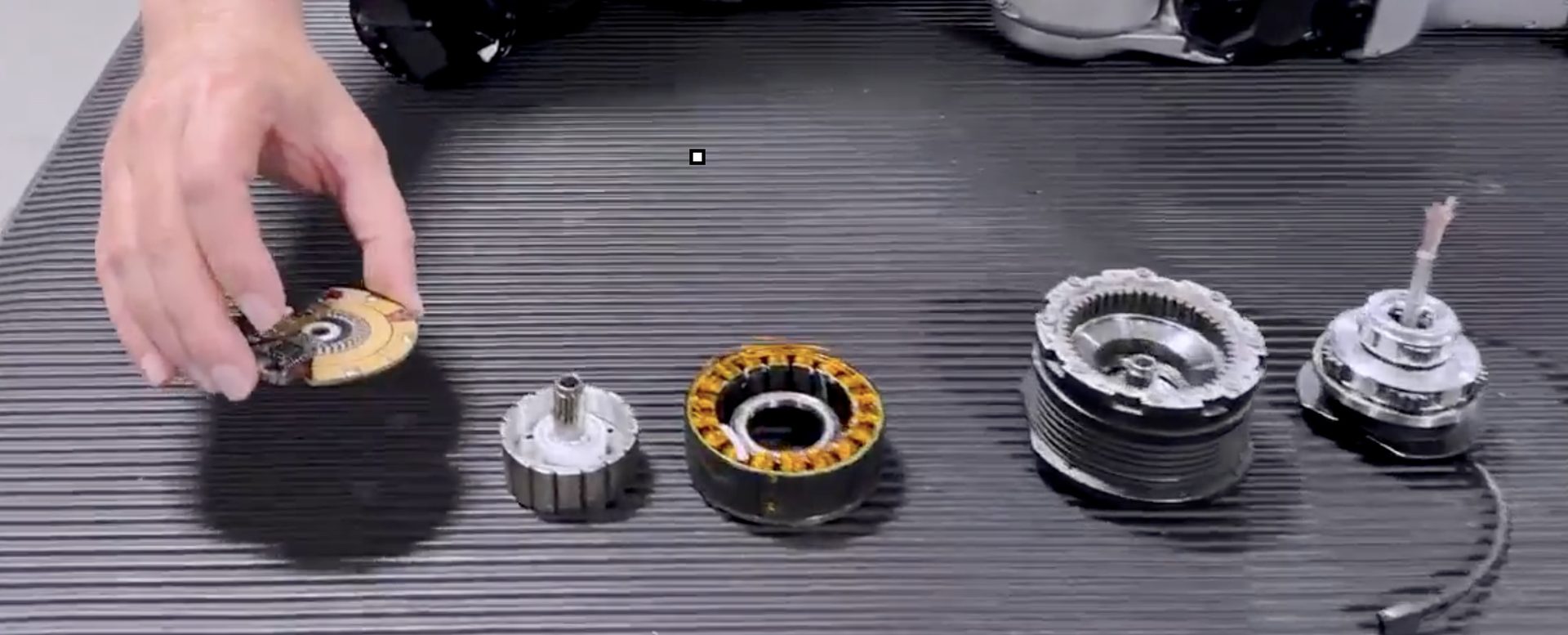
Left to right
| # | What you are looking at | What it is | Evidence |
|---|---|---|---|
| 1 | Gold circular board in the hand, small gear on it | Encoder PCB. The gear is the output-side pickup, after the reduction, not the motor commutator. | demo — Munro tape |
| 2 | Silver can, white hub, toothed pinion standing up | Inner rotor. Sixteen magnet segments around the rim. The pinion is the first-stage sun. | demo — Munro: "16 magnets. So that's 16 poles." |
| 3 | Copper ring, windings around each tooth | Stator. Concentrated, tooth-wound. Eighteen slots. Rotor spins inside. | demo — Munro: "18 teeth or 18 slots." |
| 4 | Finned aluminum cup with coarse internal teeth | Gearbox housing. Those teeth are planetary ring gears, not a strain-wave circular spline. | demo — Munro: "two-stage planetary gear set." |
| 5 | Assembled output, shaft up, cable out | Cross-roller output and the hollow run for the harness. | demo — Munro + Grant knee notes |
The fourth piece is the one people misread. Strain-wave circular splines have fine teeth. These teeth are coarse. Munro is explicit on the architecture: "they're using planetary gear reduction," and strain-wave or cycloidal only comes up as the option "when you want to go to higher ratio… 20 to 50 and then even as high as 100 or more." This joint is not that option.
Unitree's own G1 sheet calls the motor a "Low inertia high-speed internal rotor PMSM." That matches the picture: magnets on the inside, copper on the outside, stack height kept short.
The motor, in Munro's units
"This particular rotor has 16 magnets. So that's 16 poles. And the stator has 18 teeth or 18 slots." Inner rotor. Windings "wrapped tightly around each tooth" so the copper overhang is short. Munro flags the compromise in the same breath: with 18 teeth, "trying to create a 16 pole magnetic field is not perfect. You end up with a magnetic field that has a lot of harmonics in it." A traction motor would weave windings across many more teeth and buy a cleaner sine. This motor buys package.
An independent knee teardown posted by Grant on 25 August 2026 measured the same 18-slot / 16-pole count on a G1 knee: rotor OD 50.6 mm, stator ID 51.8 mm, 0.6 mm single-side air gap, magnets 2 mm thick by 20 mm axial. That is a second tape, not Munro's. It agrees on the electromagnetic recipe. It does not prove this frame is a knee.
The inverter sits on a compact board Munro clocked at "over 100 amps at peak load." Six switches. Three phases to the motor, three on the DC bus. That board is not in the five-piece explode; it is the thing that turns a torque command into current.
Three ratios, one robot
Do not flatten the gearbox into one number.
| Source | Subject | Ratio they stated | Kind |
|---|---|---|---|
| Munro Live, 11 Sep 2026 | "this particular" actuator on the table | 7.77:1, two-stage planetary | demo |
| Munro Live, 8 Jul 2026, as recapped by FabScene | G1 joints generally | about 15:1, two-stage planetary | press of a demo |
| Grant, 25 Aug 2026 | G1 knee, teeth counted | 22.5:1 (4.5 × 5.0). Stage 1: 16T sun, 4 × 20T, 56T ring. Stage 2: 12T sun, 4 × 18T, 48T ring | posted measurement |
| Munro, same 11 Sep tape | two-stage planetary as a class | "we've seen cases up to about 20 to 1" | demo |
Those are not contradictions until someone claims they are the same SKU. Munro, on this tape: "There isn't really a one-size-fits-all when it comes to actuators." Legs are larger than arms. The calf reuses the smaller arm-class unit. Unitree's sheet puts knee peak at 90 N·m on the base G1 and 120 N·m on EDU, with arm load about 2 kg / 3 kg. Different joints, different stacks, same architecture.
Grant weighed the knee at 1,085.1 g with cable and read an IKO CRBT505A on the output race. That bearing is a named Japanese cross-roller. A March 2026 China Post Securities G1 note put cross-rollers at Luoyang Baina and planetary gears at Meihu. Those can both be true across SKUs. They are not the same claim, and this desk does not pick a winner from a still.
What this is worth, and what it is not
Citrini's May 2026 line, quoting Musk, is that actuators are 56 percent of the Optimus bill. McKinsey's band, as restated in Unitree IPO coverage, is 40 to 60 percent for humanoids as a class. Both numbers describe a stack that, in most decks, still has a strain-wave in the middle of each joint.
This picture is the other book.
SemiAnalysis, as restated by RoboStrategy in August 2026, put a high-end G1 bill at $8,976 against a pretax selling price of about $27,300, and said purchased parts are 14 to 18 percent of Unitree's cost. The same research family puts QDD planetary efficiency at 95 to 98 percent against 85 to 90 percent for strain-wave, and cost "as little as 20 percent of the latter." Core Matter, 12 August 2026, called Unitree's "actuator architecture with no harmonic reducers" the most consequential reducer-market disclosure from the IPO roadshow, and graded it filing-grade.
Our hardware desk still lists Harmonic Drive CSF on the street at $900–4,000 and Leaderdrive LCS at $120–700. Those are strain-wave prices. They are not the price of the part in this photo. We do not have a factory quote for this SKU, so we are not going to invent one.
The G1 itself is the downstream number that is on a spec sheet: US $13,500 for the base body, about 35 kg, 23 degrees of freedom, 23–43 on EDU. Munro, looking at the table: "something like two dozen of these actuators." Twenty-three joints on the base sheet is the manufacturer number that matches.
The chain, two hops
Up. Sintered NdFeB for the 16 magnets — China is 94 percent of that production, Core Matter, citing the magnet chapter. Copper for the 18 concentrated teeth. A crossed-roller on the output (IKO on Grant's knee). Planetary suns, planets, rings that any competent hobbing shop can cut. Needle bearings in the planets. A gold encoder board and a plastic pickup gear. None of that is a flexspline that has to flex for a decade without cracking.
Peer. Harmonic Drive, Leaderdrive, Laifual, HIWIN DATORKER, Cone Drive. That is the strain-wave row. This robot is not their volume on the G1. They remain the row for anyone still building the 50:1–100:1 joint. Do not write them off because Unitree walked away. Do not write them in as G1 content.
Down. A $13,500 humanoid with a two-dozen-actuator bill and an in-house motor. EDU buyers, research labs, and whoever is actually putting a G1 on a shift. The work-content question is not in this still.
What is not in the record
We do not know which joint this exact frame is. Munro showed arm and leg. The hand in the shot gives scale, not a serial number.
We do not have a dollar cost for this SKU. $8,976 is a SemiAnalysis whole-robot bill, restated, not a joint quote.
We have not measured backlash, grease, or L10 on this unit.
We have not confirmed Meihu or Baina against the parts on this mat.
We have not opened an H1, an H2, or an R1. "Most joints are QDD" is the IPO-roadshow read. It is not a teardown of the rest of the house.
The honest sentence: the exploded G1 joint is a two-stage planetary actuator, not a strain-wave. That absence is the Unitree cost architecture.
If you use this note
Quote the sentence you actually used. Link the URL. If you want the referral on the citation, append `?via=yourcode` — mint the code at Take.
"The exploded G1 joint is a two-stage planetary actuator, not a strain-wave. That absence is the Unitree cost architecture." Source: Roboterminal · https://roboterminal.app/posts/g1-joint-five-parts
The monitor stays free when the quotes come back with a link.
Sources
- Munro Live, Unitree G1 Actuator Teardown, 11 Sep 2026
- Munro Live short, the tiny inverter board
- Unitree G1 spec
- Grant, G1 knee actuator measurements, 25 Aug 2026
- FabScene recap of the July Munro/Schaeffler G1 session
- Core Matter, who supplies actuators and reducers
- RoboStrategy, Unitree IPO primer
- SemiAnalysis Unitree report, as carried by Futunn
- Tanay Jaipuria on the Unitree IPO filing
- Citrini, actuators 56 percent of Optimus
Sources
- Munro Live, G1 actuator teardown
- Munro Live, G1 inverter board
- Unitree G1 spec
- Grant, G1 knee measurements
- FabScene, July Munro/Schaeffler G1 session
- Core Matter, actuators and reducers
- RoboStrategy, Unitree IPO primer
- SemiAnalysis Unitree report via Futunn
- Tanay Jaipuria, Unitree IPO filing
- Citrini Research