


 ID Logistics
2026-11-04 · Ian Lapham
ID Logistics Will Run a Live Humanoid Pilot in Germany Within Six Months. The Robot on the Floor May Not Be the Unitree It Trained On.
French contract-logistics group ID Logistics and German integrator Terra Robotics said on November 2 that their strategic partnership, effective November 1, will move from twin sorting demos to a live pilot at one of ID Logistics' German sites within six months. Each company already runs a Unitree G1 that can tell boxes from mailers, but the partners say warehouse work needs different robots for different jobs and will pick the pilot hardware from Terra's multibrand catalog, which includes UBTECH.
ID Logistics and Terra Robotics said on November 2 that they entered a strategic partnership, effective November 1, to move humanoid robots from demonstrations onto a live contract-logistics floor in Germany (press release). The French contract-logistics group, which reported €3.7 billion in revenue in 2025 and runs 450 sites worldwide, including 17 in Germany, plans a first pilot at one of those German warehouses within six months. Terra Robotics, the Wortmann Group integrator that distributes Unitree robots in the German-speaking region, will supply the hardware and integration. Neither company disclosed financial terms, named the pilot site, or said how many robots the live test will use.
Our view: This is a contract-logistics operator treating humanoids as a portfolio bet, not a single-vendor rollout. Robin Otto, chief executive of ID Logistics Germany, said the year-long sorting demo taught the partners that "we need different robot types for different tasks in warehouse logistics" and that "there will not be a universal solution for all logistical tasks." Terra Robotics chief executive Murat Arpaci said logistics is "one of the sectors with the greatest potential for humanoid robotics in the coming years, alongside production," but the six-month plan explicitly leaves open which humanoid brand goes to the floor. That is a different posture from U.S. expansions tied to one robot model, and it matches how most third-party logistics firms actually buy automation: through integrators who can swap vendors when a task changes.
The twin robots that got them here
The partnership did not start on November 1. About twelve months earlier, ID Logistics and Terra Robotics each bought a Unitree G1 EDU6 humanoid for a joint logistics showcase (press release). ID Logistics named its machine IDA and runs it in Griesheim, near Frankfurt. Terra Robotics named its Heinz and runs it in Löhne, in North Rhine-Westphalia.
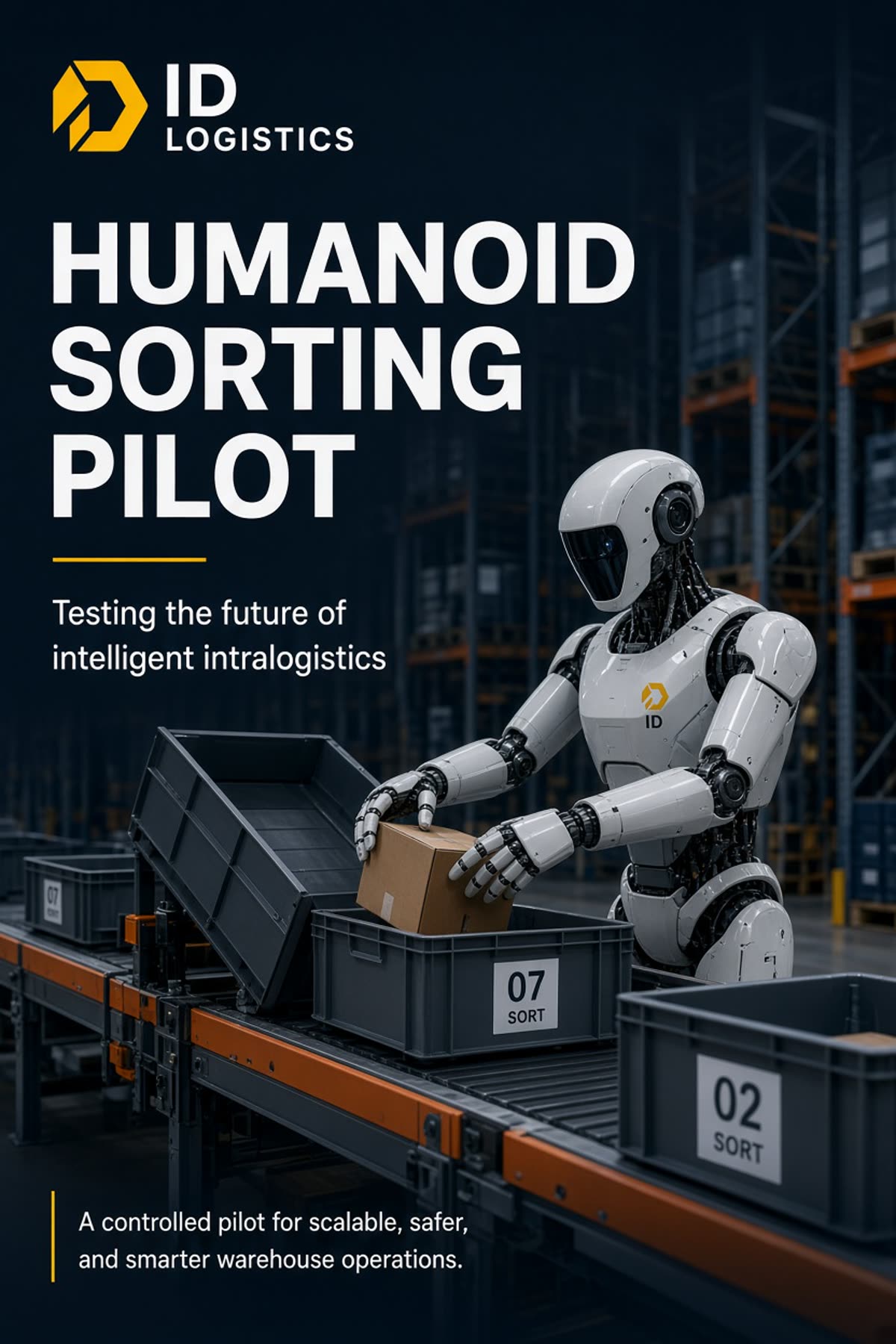
The two companies programmed the pair in tandem so engineers in both cities stayed on the same software version while learning a sort task. Arpaci said they used the robots "to bridge the spatial distance between our teams and always be at the same level during programming." The robots can now distinguish cardboard boxes from shipping bags and sort each type with five-finger tactile hands into shipping bins, according to the release and photos ID Logistics supplied.
That work happened off the production floor. It is the baseline the partners will now try to stress-test under shift speed, damaged labels, and mixed inbound volume.
What the six-month pilot will decide
The roadmap is deliberately narrow. In the first step, ID Logistics and Terra Robotics will list four or five candidate workflows, among them picking, sorting, packaging, and other repetitive contract-logistics tasks, and write down the technical and operating requirements for each. In the coming weeks they will pick one task for the first live pilot.
Only then will Terra choose a robot from its multibrand catalog, which the release says includes humanoids from UBTECH and Unitree. The pilot machine "will be selected and provided for the practical test," and programming will again happen in tandem across the two sites. The robot will run "for the first time under real operating conditions" at a selected ID Logistics location.
The release does not promise that the live pilot uses another G1, or even another Unitree. Sorting boxes and mailers is one grip-and-place problem; picking garments or building mixed pallets is another. Otto's multibrand comment is the clearest signal that ID Logistics expects to match hardware to task rather than standardize on a mascot robot.
Why contract logistics is a plausible first customer
Third-party logistics operators sit between brands and carriers. ID Logistics handles distribution, e-commerce fulfillment, consumer goods, cosmetics, and fashion across sites that share processes but not identical layouts. Otto described German logistics as the country's third-largest economic sector, with "often uncomplicated, millions of times recurring work steps" that could suit humanoids if the right tasks are found.
That language stops short of a return-on-investment claim. The release frames the pilot as a way to "gather experience on the shop floor" and "explore the technical possibilities and limits of humanoid robotics," with scaling left to a later phase. For a listed operator with 55,000 employees and ten million square meters of warehouse space, the cost of one pilot is small; the reputational cost of picking the wrong task or robot is not.
Terra Robotics, through its Terra Connect unit, reported about €40 million in revenue in 2025 on a staff of 57, backed by Wortmann AG, a European IT distributor with roughly €2.5 billion in annual revenue (press release). Its role is to translate vendor hardware into workflows ID Logistics can bill for. The July partnership announcement on Terra's site already positioned the Unitree G1 as a demonstration platform, not the final form factor (Terra Robotics).
Objections
"Twin demo robots mean nothing for production." Correct on throughput. The value here is organizational: two companies aligned software remotely before betting a live site. The pilot is the first test that matters.
"Europe is behind the U.S. on humanoid deployments." U.S. headlines feature named robots at named customers, but several of those customers have also said payback is not there yet. ID Logistics is earlier and more explicit about testing limits before scaling.
"Multibrand is integrator talk for not committing." It can be. It can also reflect real task diversity inside one logistics network. The check is whether Terra and ID Logistics publish which robot runs which task after the pilot, not just that they could have chosen differently.
Three things to check
- Which site and task ID Logistics selects. The release says the choice comes in the next few weeks. A sort-heavy inbound hub would extend the G1 demo; a pick-heavy e-commerce module would likely force a different gripper and base.
- Which robot model Terra deploys. If the live pilot stays on Unitree, the G1 sorting skill transfers cleanly. If Terra ships UBTECH or another brand, watch how much software ID Logistics must rewrite.
- Any operating metric under shift conditions. Neither company has published picks per hour, mis-sort rate, or downtime for IDA and Heinz. The first numbers from a live German site, not a showcase room, are the ones operators will compare to AMRs and fixed automation.