


 Robros
2026-10-14 · Ian Lapham
Korea Let 20 Humanoids Work Without a Fence. The Safety Standard for Them Isn't Written Yet.
South Korea cleared 20 Robros humanoids on October 13 to work beside people at a chip plant, an auto supplier, a shipyard and a cold-chain site without the 1.8-meter fence its rules require. The ISO standard for balancing robots is still a committee draft, the EU's new machinery rules apply in January, and the companies logging hours on shared floors are the ones writing the rule.
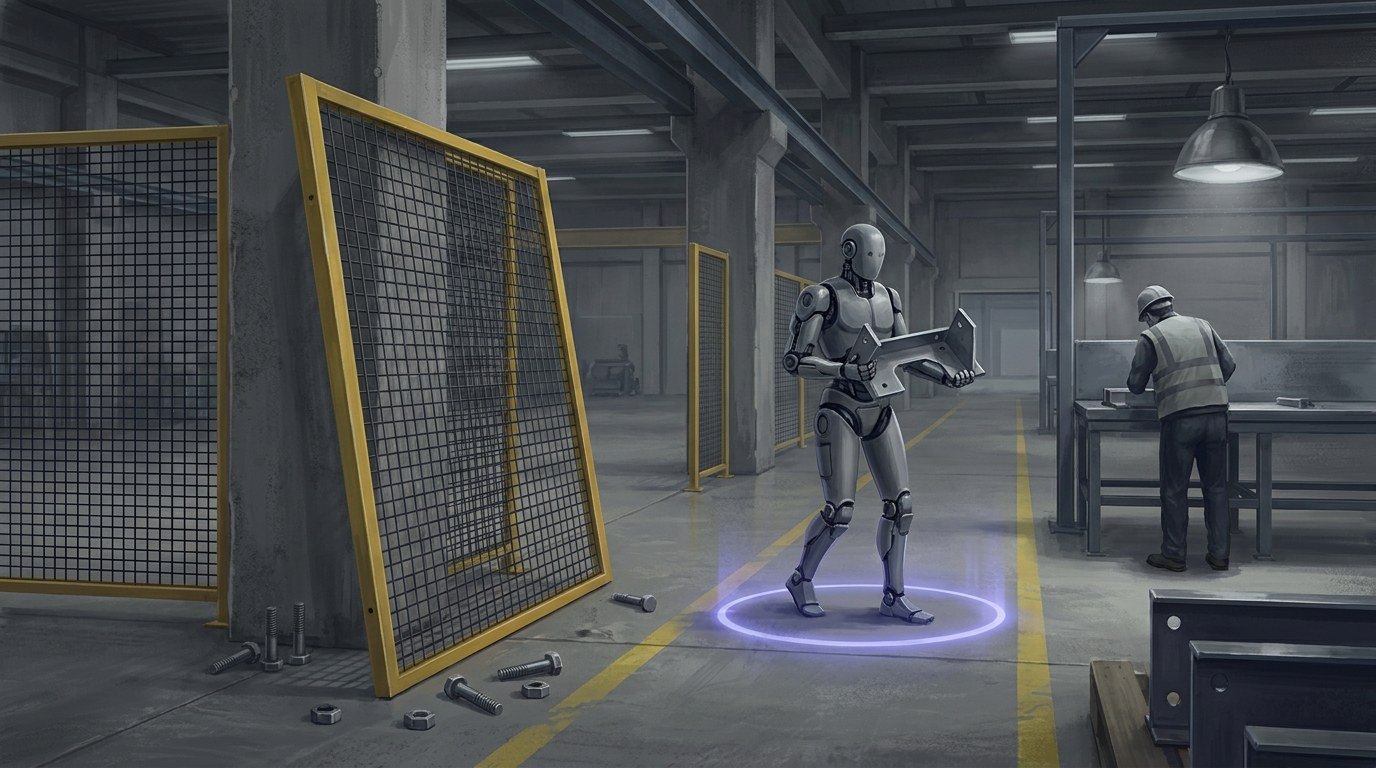
South Korea's trade ministry on October 13 cleared 20 Robros IGRIS-C humanoids to work in spaces shared with people at four industrial sites, without the fence of at least 1.8 meters that Korean workplace safety rules require around an industrial robot (https://en.sedaily.com/finance/2026/10/13/korea-clears-first-factory-test-of-20-humanoid-robots; https://roboticaguide.com/korea-humanoid-robots-factories-robros-igris-c/). The international safety standard meant to cover that class of machine, ISO/CD 25785-1, was approved as a project on May 22 2025, closed its committee draft comment period on July 8 2026, and has no publication date (https://humanoidversus.com/policy/iso-25785-1). The draft's scope term is "actively controlled stability," which the ISO catalogue defines as a robot "that requires an active control in order to remain balanced and could become unstable in the absence of power" (https://www.iso.org/standard/91469.html). In plain words: a fixed arm bolted to the floor stays put when the power is cut, and a walking humanoid falls over. The fence rules written for the first kind of machine assume it stays where it was bolted.
The Korean government says the point of the trial is to produce the replacement. Seoul Economic Daily's account is direct: "Until now, humanoid deployment had been permitted only as an exception through company-by-company sandbox approvals. The government intends to use data from the tests to rewrite safety standards and open the technology to manufacturing more broadly." Our view: for humanoids near people, the binding constraint over the next 18 months is permission, not capability, and the permission is being written from field data that the first movers generate. Korea's sandbox is a rule-writing exercise disguised as a deployment. The fence is the rule. Taking it down means writing a new one.
The fence rule, and why a walking robot breaks it
Korea's Occupational Safety and Health Standards Rules, Article 223, require a fence at least 1.8 meters high around an industrial robot, or sensor-based protective devices where a fence is not practical, per Robotica Guide. The main exception is for robots the labor minister recognizes as meeting Korean or international standards, which in practice means fixed collaborative arms. That exception does not help a biped. The international standard for a robot that balances is still a draft, so there is nothing published for the minister to recognize.
Seoul Economic Daily puts the mismatch plainly: "Current safety standards for industrial robots assume stationary machines and require safety fences and other barriers to separate people from robot work areas. That structure does not fit humanoids that move near workers." Korea is where that mismatch bites hardest. The country had 1,220 industrial robots per 10,000 manufacturing workers in 2024, the highest density in the world (Robotica Guide, citing IFR). It installed 30,200 new industrial robots last year against China's 354,200, per IFR figures in Seoul Economic Daily, so China installs about 11.7 times as many (arithmetic). But Korea has more industrial robots per worker than anyone, nearly all of them fixed machines behind guarding, per Robotica Guide, and the fence is the thing a humanoid cannot live behind.
The sandbox does not scrap Article 223. The exemption is conditional on a risk assessment and risk-reduction measures under the Ministry of Employment and Labor. Choi Soo-yeon of the ministry's industrial regulation innovation division told the Hankyoreh, per Robotica Guide: "The pilot will proceed on the premise that the companies take safety measures to reduce risk." Trade Minister Kim Jung-kwan told the Hankyoreh, per Robotica Guide, that "the key is not to remove regulation unconditionally." His framing to Seoul Economic Daily was faster: "AI technology is advancing so fast that regulation struggles to keep up," and "We need to quickly remove the institutional bottlenecks that keep companies from applying new technology on industrial sites."
None of the jobs is exotic. At Nepes the robots remove contaminants from circular components in back-end semiconductor packaging. At Sungwoo Hitech they place auto body parts in designated positions. At HD Hyundai Samho they stack scaffolding brackets that secure elevated work platforms to a ship's hull. At Delivery Lab they move refrigerated logistics packaging. What the four sites have in common is people moving through the same aisles.
The gates a humanoid has to clear before it can work near people
Five documents shape whether a balancing robot can share a floor with workers in the markets covered here. Three of them decide how safe it has to be. One attaches a legal mark. One asks where it was built.
| Gate | Who writes it | Status as of Oct 14 2026 | What it decides |
|---|---|---|---|
| Korea, Article 223 plus the Industrial Convergence Regulatory Sandbox | Ministry of Employment and Labor (rule); Ministry of Trade, Industry and Energy review committee (exemption) | Rule in force. Robros exemption granted Oct 13 at the committee's sixth meeting this year, conditional on risk assessment. No start date, duration, or draft replacement rule published. | Whether a robot may work near Korean workers without a 1.8 m fence or sensor barrier |
| ISO/CD 25785-1 | ISO/TC 299; eventual vote by 89 voting nation members (https://arstechnica.com/ai/2026/09/agilitys-new-humanoid-robot-will-stop-squat-to-avoid-harming-human-coworkers/) | Committee draft registered May 8 2026; comment period closed Jul 8 2026 (stage 30.60); no publication date; Part 2 on application integration planned | Safety requirements for dynamically stable industrial mobile robots in workplaces where the public is excluded; the reference the other gates will point to |
| ANSI/A3 TR R15.108 | A3 technical committee; Agility Robotics is project leader (https://www.agilityrobotics.com/content/agility-unveils-digit-5-humanoid-robot-built-for-cooperatively-safe-work-at-scale) | Technical report under development | US and Canada guidance for the same robot class |
| EU Machinery Regulation 2023/1230 | European Union; technical detail mainly through harmonised standards (https://osha.europa.eu/en/legislation/directive/regulation-20231230eu-machinery) | Applies from Jan 20 2027; replaces Directive 2006/42/EC | CE marking; third-party conformity assessment for high-risk machinery; coverage of autonomous mobile machinery and AI "where specific modules of AI using learning techniques ensure safety functions" |
| FCC Covered List, advanced robotic devices | FCC, following a White House-convened interagency determination; Department of War for exemptions (https://www.fcc.gov/covered-list-faqs-robots-inverters) | Foreign-produced mobile robots added Jul 28 2026; FAQ updated Oct 2 2026 | Whether a new foreign-produced humanoid or quadruped can be authorized, imported, marketed or sold in the US at all. Fixed arms excluded. |
Only the first row has produced an actual permission for humanoids on a shared floor, and it did so by exemption. The ISO draft that the other rows lean on took about 13.5 months to get from project approval to the close of its first committee comment round (arithmetic), and it has no date for the next stage.
What the companies are doing instead of waiting
The two companies with the most public safety claims for humanoids near people have converged on the same behavior. Slow down. Stop. Sit.
IGRIS-C, the Robros machine in the Korean trial, is 154 cm tall and weighs 56 kg, runs a 48 V 17,000 mAh battery with a 2.5-hour charge, and has about 43 degrees of freedom by Robotica Guide's count. Its listed safety features are force limiting, collision detection, emergency stop and a collaborative mode. Robros CEO Noh Seung-jun told the Hankyoreh, per Robotica Guide, that IGRIS-C slows down when it senses people nearby and stops if they come closer, and that if a person shuts it down after a fault it sits down where it stands. During the trial the robot works on its own while a person watches. There is no outside data on how often that person intervenes. Robros told Seoul Economic Daily it has sold 18 IGRIS-C units and aims to pass 50 built by year end, and says a Lotte Global Logistics pilot running since early 2026 reached "minimal human intervention." Those are company claims and are not independently verified. Taken at face value, the 20-robot trial is larger than the 18-unit installed base the company reports (arithmetic).
Agility Robotics unveiled Digit 5 on September 15 as "the first humanoid robot engineered for cooperatively safe work at scale," meant to work close to people "without the physical safety barriers required by traditional automation." Its safety stack is safe human detection that makes the robot avoid, stop or assume a seated position; visual and auditory cues; and an independent safety controller. It is the first launch partner for NVIDIA Halos for Robotics on IGX Thor. Agility also claims Digit was "the first humanoid to pass an independent field evaluation on a customer production line for industrial safety standards administered by" OSHA. That is a company claim; no evaluation document is cited in the release. Digit 5 weighs 129 kg and stands 1.81 m, lifts up to 22.7 kg, and runs 90 minutes on a 9-minute charge. It is about 2.3 times the mass of IGRIS-C (arithmetic), which matters for what a stop or a sit means to the person standing next to it.
Agility's CTO Pras Velagapudi drew the line that the standards bodies are also drawing. In pallet and aisle scenarios, he told Ars Technica, "it's not really practical to constrain the robot within a physical safety cage." Cooperative safety means working in the same space at a safe distance. Collaborative safety, working directly with humans in close proximity, is the next step, once proven. Co-founder Jonathan Hurst had earlier called safety a "blocker for everybody." Agility reports more than 65,000 hours of Digit 4 operation with customers including GXO, Schaeffler, Amazon and Toyota Motor Manufacturing Canada, with GXO's Flowery Branch site at 100,000 totes and about 98 percent on-task accuracy, and says it held more than $300 million in multi-year Digit 5 orders as of May 2026 "subject to satisfaction of certain contractual milestones." Early access is planned for the first half of 2027, general availability by the end of 2027, and Digit 5 is "expected to carry a CE mark."
Sitting down is the engineering answer to actively controlled stability. A robot that is already on the floor cannot fall onto anyone. Both companies have built that answer into the product before any standard told them to, and both are now in a position to show regulators what the answer looks like in hours of operation rather than in a draft.
The calendar runs backward: the regulation applies before the standard is finished
Regulation (EU) 2023/1230 applies from January 20 2027. It replaces the Machinery Directive, extends coverage to autonomous mobile machinery and to AI safety functions, requires third-party conformity assessment for high-risk machinery, and leaves most of the technical detail to European harmonised standards. The humanoid-specific standard it would lean on, ISO 25785-1, is still in committee. BSI's UK portal lists BS ISO 25785-1 under AMT/10 with drafting from October 7 2026 and public comments from January 8 to March 9 2027 (https://noonelite.com/humanoid-robot-safety-standard-uk-sites/). Noon Elite's caveat: "Those are BSI's dates, and they can move." Even if they hold, the EU regulation takes effect before the UK comment window closes (arithmetic).
So if BSI's dates hold, a humanoid that carries a CE mark in early 2027 will have been assessed against a regulation whose humanoid standard is still taking comments. Agility is a contributor to ISO 25785-1, project leader on the US technical report, and plans EU and UK deployment for Digit 5. The companies helping to write the standard ship first, and what they ship becomes the evidence the standard is written against. Our view: that order of events is normal enough for a new machine class, but it means the field data in Korea, in GXO's warehouses, and on whatever European floor gets the first CE-marked humanoid is the raw material for the rule, and whoever holds that data holds the pen.
The other gate decides where the robot is built, not how safe it is
The FCC's July 28 action added foreign-produced "advanced robotic devices" to the Covered List (https://docs.fcc.gov/public/attachments/DOC-423682A1.pdf). The definition covers a mobile robot weighing more than 4.4 lb with a sensor, network connectivity of at least 200 kbps, and software, including AI model weights, controlling navigation or movement. Fixed stationary arms (articulating, delta, gantry, SCARA) are excluded. AGVs may be included. New foreign-produced models generally cannot get FCC authorization and so cannot be imported, marketed or sold in the US. Existing authorized models are unaffected. The exemptions are a Conditional Approval from the Department of War, small batches imported solely for development and testing, and sales to the federal government.
The rule is country neutral; the producer's nationality is irrelevant. "Foreign-produced" means not a "domestic end product" under 48 CFR 25.101(a): manufactured in the US, with domestic component cost exceeding 65 percent for items delivered 2024 through 2028 and 75 percent from 2029. Commercial off-the-shelf components count toward the test. By that definition, a 56 kg networked biped like IGRIS-C is in scope wherever Robros builds it, and a US-assembled humanoid can still fail on component cost. Given how concentrated humanoid joint supply is in China, which we traced at https://roboterminal.app/posts/harmonic-reducer-capacity-vs-humanoids, the 65 percent line is a gate on the bill of materials. None of it asks whether the robot stops when a person walks past.
Objection docket
Twenty robots is tiny. Shanghai recently set a goal of 8,000 humanoids in factories by 2028, 400 times Korea's trial (arithmetic). True, but Shanghai's figure is a target and Korea's is an approved exemption with four named sites and a ministry on record that the data will feed a rule. A goal does not generate field data. An exemption does, assuming the trial starts.
It is a supervised trial with no dates. Robotica Guide calls it "a supervised trial, not a commercial rollout." No start date, no duration, no intervention rates, no word on whether the new Korean standard will follow the ISO work. All conceded. Hanyang University professor Han Jae-kwon told Seoul Economic Daily that "What matters is expanding the tests and accumulating behavioral data, such as how skilled workers move," which is an argument for the trial's design and also an admission that it is early.
Robros's numbers are soft. The 18 units sold, the 50 built by year end and the Lotte "minimal human intervention" result are all company statements. The only price on record is a preorder of roughly 150 million won in July 2025 for an earlier, smaller version. We would not build a market estimate on any of it.
Rules are not the only blocker, since humanoids already work in plants. BMW deployed Figure 02 at Spartanburg, where over roughly 10 months it handled more than 90,000 parts and contributed to more than 30,000 BMW X3 vehicles. Digit 4 has more than 65,000 hours. Those are real. But the sources do not say under what fencing or zoning arrangements they ran, and Agility's own founder called safety the blocker for everybody. The capability to do a task behind a barrier or at a safe distance is established. Permission to do it in a shared aisle at scale is what remains unwritten. The IFR counts in https://roboterminal.app/posts/ifr-2025-robot-installs-vs-humanoids show how small the humanoid fleet still is next to arms, which is the same point from the other side.
Standards always lag. Yes. The difference this time is that at least one company supplying the field data, Agility, also leads the US technical report and contributes to the ISO draft, and the EU regulation takes effect before BSI's public comment window closes. The lag is normal. The order of operations is what to watch.
Three numbers to check
- A start date, a duration, and an intervention rate from Korea, followed by a draft rule. The ministry has said the trial data will rewrite the standard. Until it publishes when the robots start and how often the watching person steps in, the exemption is a promise. A draft replacement for Article 223's fence requirement, and whether it references ISO 25785-1, would show the rule-writing exercise is real.
- ISO 25785-1 moving past stage 30.60, and whether BSI's public comment opens on January 8 2027. The draft closed committee comments on July 8 2026 with no next date. A move to the enquiry stage, or the BSI window opening on schedule, would give the first fixed timeline for a standard that an 89-member vote still has to pass.
- The first humanoid CE mark under Regulation 2023/1230, or the first Department of War Conditional Approval for a foreign-produced humanoid. Agility expects Digit 5 to carry a CE mark with early access in the first half of 2027, under a regulation that applies from January 20 2027. On the US side, no new foreign-produced humanoid model can get FCC authorization without that exemption. Either event would be the first time one of these gates opens for a balancing robot on paper rather than by one-off exemption.
Korea took the fence down around 20 robots and said the new rule would come from what happens next. Until that rule exists, the fence is still the law everywhere else, and the hours logged without it are the only draft anyone has.
Sources
- Seoul Economic Daily, Korea clears first factory test of 20 humanoids
- Robotica Guide, Robros IGRIS-C in Korean factories
- ISO, ISO/CD 25785-1
- Humanoid Versus, ISO 25785-1 status
- Noon Elite, humanoid safety standard for UK sites
- Agility Robotics, Digit 5 launch
- Ars Technica, Agility's Digit 5 stops and squats near coworkers
- EU-OSHA, Machinery Regulation 2023/1230
- FCC, Covered List FAQs on robots
- FCC, Covered List public notice
- Roboterminal, harmonic reducer capacity vs humanoids
- Roboterminal, IFR 2025 robot installs vs humanoids