


 Schaeffler
 NEURA Robotics
 Humanoid
 Hexagon Robotics
2026-10-21 · Ian Lapham
Schaeffler Will Buy Thousands of Humanoids From Its Actuator Customers. Its €400 Million Order Book Doesn't Count Those Deals.
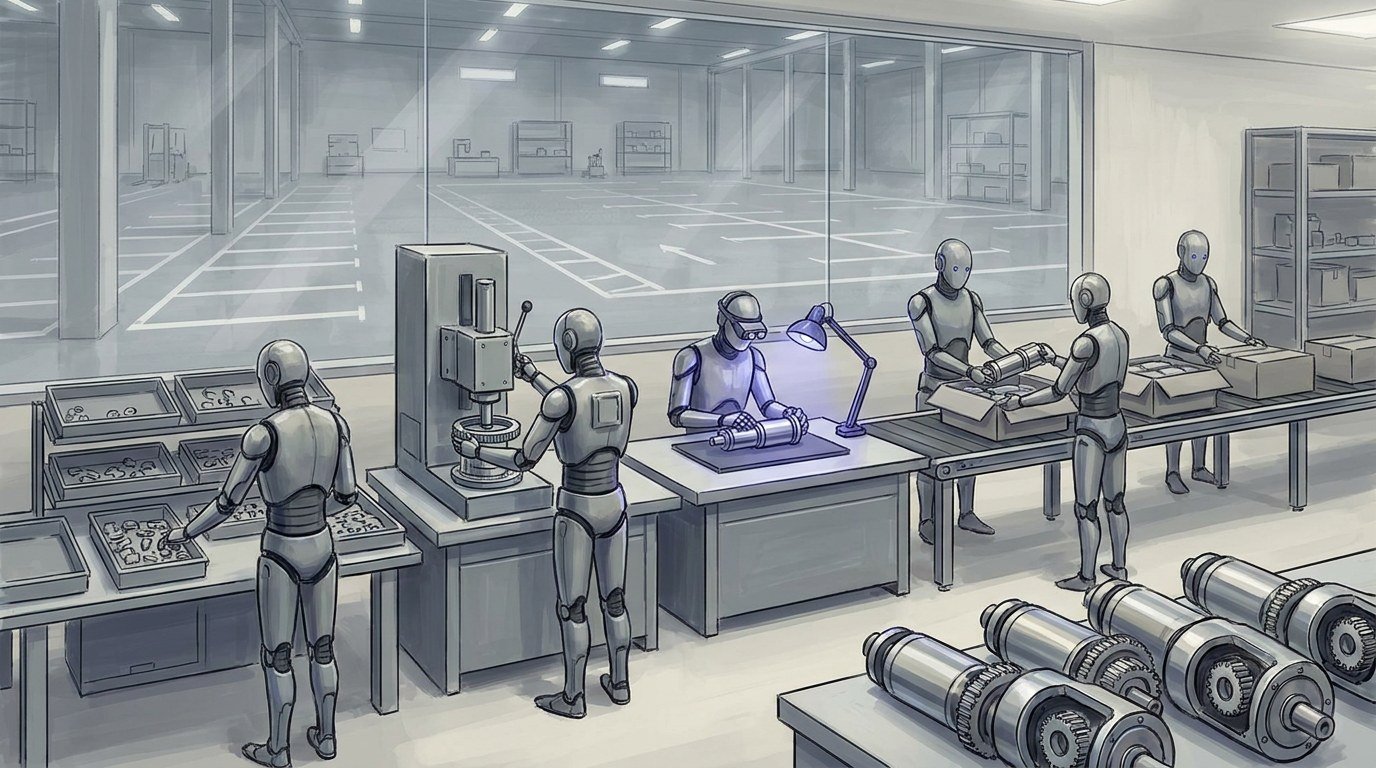
German auto and industrial supplier Schaeffler opened a plant in Taicang, China, on October 20 where six humanoids at five stations assemble actuators for other humanoids. A week earlier it put its humanoid order book at about €400 million, with five customers in series production and 83 sample orders. That figure needs a signed series-production order, takes a haircut of more than 50% per customer, and on Schaeffler's own description leaves out NEURA, Humanoid and Hexagon, the three robot makers it has pledged to buy roughly 6,000 humanoids from. What decides the rest is conversion: two customers in mass production now, three more by about April 2027.
On October 20, Schaeffler opened a lighthouse factory in Taicang where six humanoid robots work at five stations across approximately 7,500 square meters, assembling joint modules, including linear and rotary actuators, for the next generation of humanoids (https://www.schaeffler.com/en/media/press-releases/press-releases-detail.jsp?id=88222851). One week earlier, on October 13, the company said two new Greater China customers had placed production orders, lifting its humanoid order book to approximately €400 million, with five customers now in series production and 83 sample orders year-to-date (https://www.schaeffler.com/en/media/press-releases/press-releases-detail.jsp?id=88222017; https://www.investing.com/news/transcripts/earnings-call-transcript-schaeffler-q3-2026-results-show-progress-but-shares-slip-93CH-4946670).
The Taicang release does not name the humanoid models on the line. It gives no cycle time, no throughput figure and no intervention rate. The €400 million is incoming orders, not recognized revenue, a point Humanoids Daily made the same day (https://newsletter.humanoidsdaily.com/p/gemini-4-apollo-pi-api-humanoid-robotics-october-20). The October 13 numbers are preliminary; validated figures come in the interim statement on November 3.
Our view: the easy read is that a supplier buying thousands of robots from its own customers is manufacturing its own demand, and that "humanoids making humanoids" is a photo opportunity dressed as a factory. The second half of that is fair for now. The first half gets the accounting backwards. Schaeffler's order book requires a signed series-production contract, takes a haircut of more than 50% per customer, and leaves out the very reciprocal deals the circular argument points at. The €400 million is the strictest number anyone in the humanoid supply chain has published, and the deals behind the roughly 6,000 humanoids Schaeffler has pledged to buy are not counted in it (arithmetic). What decides whether this is a business is conversion: two customers in mass production today, three more due within six months, XPeng IRON starting in Q4, and Schaeffler's own fleet going from six robots in Taicang to a floor in the thousands.
What goes into the €400 million
Schaeffler first published the order book in August, at €350 million as of June 30. CEO Klaus Rosenfeld described the rules on the Q2 call (https://stockanalysis.com/quote/etr/SHA0/transcripts/553275-q2-2026/). It needs a signed order for series production to make it in. Customer volume forecasts get a haircut decided in internal committees, "above 50% to be on the safe side." The €350 million came from three major global humanoid OEMs in three regions and seven products. One name was given, XPeng. The two others were described as U.S. names that could not be disclosed. All products had SOP in 2026 or at latest Q1 2027.
An analyst asked why the Humanoid partnership, which carries a seven-digit actuator volume, was missing. Rosenfeld said that contract "doesn't meet all these standards, at least not for the June 30th," and that the company wants to be "strict and very conservative" about what goes in. RoboMorrow reported that the €350 million also excluded parts of the NEURA Robotics and Hexagon programs (https://robomorrow.com/en/schaeffler-350-million-euro-humanoid-orderbook-xpeng-iron/). Put Rosenfeld's description next to the partner list and the result is clean. At June 30 the three customers in the book were XPeng and two U.S. companies. NEURA is German, Humanoid is British and Hexagon Robotics is European. The two customers added in Q3 are Chinese. On Schaeffler's own description, none of the three companies it buys robots from is among the five customers in the book.
Then it grew. Two China-based customers placed production orders during Q3, taking the book from €350 million to €400 million, a €50 million or 14% increase in a quarter (arithmetic). Customer count went from three to five. One existing global OEM sourced Schaeffler for an additional product. Mass production across multiple products has started for two customers, with the remaining three scheduled to begin within the next six months (https://www.investing.com/news/company-news/schaeffler-q3-2026-slides-eur-240mn-cleanup-humanoid-growth-93CH-4946711). Sample orders stood at 83 year-to-date, which the slides call an increase of almost 300% on 2025. Schaeffler has not identified the two new customers or their contract values (https://korthosrobotics.com/research/schaeffler-humanoid-orders-400-million-china).
If the haircut were applied uniformly at exactly 50%, the customers' own volume forecasts would sum to at least €800 million (arithmetic). Schaeffler says per customer and "if not more," so the true pre-haircut figure is unknowable from the outside, but the direction is clear.
Scale matters here. Group revenue for the first nine months was €17.5 billion. The order book is 2.3% of that (arithmetic), and even that comparison flatters the humanoid business, because the book is multi-year and the revenue is nine months. TechQuire puts the humanoid business at less than 1% of group sales in 2025 (https://www.tech-quire.com/articles/schaeffler-humanoid-robotics-orders-400-million-euros/). The rest of the company is working through a 4.5% nine-month EBIT margin before special items, roughly €240 million of E-Mobility one-off charges, an E-Mobility margin of minus 14.8%, and a headcount reduction of 6,143 since December 2024. Shares fell 1.02% after the call. The humanoid line is a growth story inside a restructuring story, and Rosenfeld said as much: "the hype that was there at the beginning is coming down a bit."
Schaeffler as customer and supplier
Three deals run the other way. In each, Schaeffler supplies actuators and commits to buying robots.
NEURA Robotics came first, in November 2025. Joint development and supply of key components such as actuators, plus an offtake agreement under which Schaeffler will "integrate a mid-four-digit number of humanoids into its production by 2035" (https://www.schaeffler.com/en/media/press-releases/press-releases-detail.jsp?id=88136515). NEURA secures a large share of its requirement for compact, lightweight planetary gear actuators. Humanoids Daily called it "a two-way relationship where Schaeffler will become both a key customer for Neura and a critical component supplier" (https://www.humanoidsdaily.com/news/schaeffler-commits-to-thousands-of-neura-humanoids-in-deep-component-and-ai-partnership).
Humanoid, the UK company, followed in January and firmed up in May. The May agreement is described as binding and phased, targeting "a four-digit number of wheeled units across Schaeffler's global facilities by 2032" on a Robot-as-a-Service model (https://thehumanoid.ai/humanoid-secures-landmark-deal-with-schaeffler-to-deploy-thousands-of-humanoid-robots/). The initial phase runs December 2026 through June 2027 at Herzogenaurach, on box handling, and Schweinfurt, with a three-month capability demonstration followed by three months validating continuous operation. In return Schaeffler becomes preferred supplier covering more than 50% of Humanoid's joint-actuator demand for wheeled platforms through 2031, which Humanoid expects to translate into a seven-digit number of actuators. The January release specified strain wave gear actuators for upper body, shoulders and arms (https://www.schaeffler.com/en/media/press-releases/press-releases-detail.jsp?id=88159744).
Hexagon Robotics came in April. Schaeffler develops and supplies strain wave and planetary gear actuators for AEON and plans to deploy at least 1,000 AEON humanoids across its production system by 2032 (https://www.schaeffler.com/en/investor-relations/events-publications/ir-releases/ir_releases_detail.jsp?id=88184988). That follows a 2025 pilot where AEON loaded, unloaded and inspected parts at a multi-machine station on wheels. Automated part inspection is targeted for rollout starting end of 2026, and AEON entered Schaeffler's Humanoid Gym in Germany in August (https://hexagon.com/company/newsroom/press-releases/2026/towards-factory-deployment-how-aeon-is-trained-to-perform).
| Partner | What Schaeffler supplies | What Schaeffler buys | Timeline | In the order book |
|---|---|---|---|---|
| NEURA Robotics | Planetary gear actuators, up to 250 Nm | Mid-four-digit number of humanoids | By 2035 | Parts excluded as of June 30 |
| Humanoid (UK) | Joint actuators for wheeled platforms, >50% of demand, seven-digit volume | Four-digit number of wheeled units, RaaS | First phase Dec 2026-Jun 2027; fleet by 2032 | Excluded as of June 30 |
| Hexagon Robotics | Strain wave and planetary actuators for AEON | At least 1,000 AEON | Inspection rollout from end 2026; fleet by 2032 | Parts excluded as of June 30 |
Add the floors. Mid-four-digit read as roughly 4,000, plus at least 1,000 from Humanoid, plus at least 1,000 from Hexagon, gives a floor near 6,000 robots by 2035 (arithmetic). Schaeffler has approximately 100 manufacturing plants, so that is about 60 robots per plant (arithmetic), and about 5.5% of its 108,912 employees at June 30 (arithmetic). Taicang runs six today. The pledge is a thousand times that (arithmetic).
Whether those pledges convert is a separate question. The Hexagon and Humanoid deadlines are six years out. NEURA's is nine. But the pledges are public, binding in Humanoid's case, and none of them inflate the €400 million.
Why a bearings company wants to be its own first customer
Actuators make up around half of the total cost of manufacturing a humanoid, by Schaeffler's own estimate (https://www.schaeffler.com/en/media/press-releases/press-releases-detail.jsp?id=88210241). That is the company's claim and it is the reason the whole strategy exists. Schaeffler's edge, as it tells it, is forming. Its formed strain wave gearboxes cut manufacturing cost by more than 25% and material consumption by more than 75% versus the conventional route, with key steps taking seconds instead of minutes. Validation is done. Mass manufacturing starts in 2027 in Germany, then other regions. The automotive side has already shipped more than 2 million formed strain wave gearboxes over the last ten years.
The long-term arithmetic Rosenfeld gave in August: 1 million humanoids in 2035, which he called conservative, at least a 10% market share, and 50% of the bill of materials addressable. Ten percent of a million is 100,000 robots' worth of content in 2035 (arithmetic). At roughly 14 harmonic reducers per Optimus-class robot, an order-of-magnitude figure from EYOU (https://eyoubot.com/en/industry-news/mirle-main-drive-harmonic-reducer-capacity-expansion), that is about 1.4 million strain wave gears a year, against the automotive side's ten-year average of about 200,000 a year, so roughly seven times that pace (arithmetic). We covered why that capacity question matters across the whole reducer industry in an earlier post (https://roboterminal.app/posts/harmonic-reducer-capacity-vs-humanoids). Makers mix harmonic and planetary, so treat the multiple as directional.
Taicang is where the production side and the customer side meet. The release says the factory "marks the start of mass production of these components for Schaeffler." The six robots on the line are doing the work Schaeffler wants to sell actuators into: staging and sorting parts, joining, inspecting, labeling, packaging. A digital twin records assembly accuracy, work-step duration, energy and asset condition. The training and data center teaches humanoids visual inspection, packaging, material transport, container moving and line-side replenishment, in environments oriented to conditions in Schaeffler's approximately 100 plants.
David Kehr, who runs the humanoid business, put the logic in one sentence in August: "We deploy humanoids along our entire global value chain and therefore have first-hand knowledge of the requirements." COO Jochen Schröder called Taicang "a closed manufacturing loop where humanoids assemble components for humanoids." Strip the branding and the point is that Schaeffler is building the test bed for the actuators it sells, inside the plants that will eventually hold the 6,000 robots it has promised to buy. The 119 physical AI and humanoid patents applied for since January 2025 and the platform approach, one actuator family rather than 50 bespoke designs for 50 customers, follow from the same idea. A supplier that runs robots learns what breaks.
Objection docket
"This is vendor financing. Schaeffler buys the robot, the robot maker buys the actuator, and both book revenue." It would be, if those deals were in the €400 million. They are not, by Schaeffler's own statement and by RoboMorrow's reporting. The reciprocal volumes also do not balance the way the objection implies. Humanoid expects a seven-digit actuator supply; at LG's general estimate of about 30 actuators per humanoid (https://finance.biggo.com/news/10fd5df0-89fc-4c39-a6be-623291f085e9), one million actuators is roughly 33,000 robots' worth (arithmetic), while Schaeffler's purchase from Humanoid is a four-digit number of units. Wheeled platforms may use fewer actuators and the per-robot count is not disclosed, but the gap is not close. However, cash does flow both ways, the Humanoid deal is Robot-as-a-Service, so Schaeffler pays for robots as a service, and the three partners get an anchor customer that happens to be their supplier. That is a real conflict of interest. It is just not in the number people are quoting.
"€400 million is a rounding error for a company with €22.5 to €24.5 billion in guided sales." True. The book is 2.3% of nine-month revenue (arithmetic), and the humanoid business was under 1% of group sales in 2025. The company itself frames humanoids as one of four growth areas, not a replacement for the E-Mobility problem. The case for paying attention is the conversion schedule rather than the size: two customers in mass production, three more inside six months, seven products at June 30 and at least one more sourced since. A €400 million book that converts on time tells you more about actuator demand than a memorandum of understanding ten times its size.
"Six robots at five stations is a stunt." Fair, on today's disclosure. The output is joint modules, as Humanoids Daily noted. No throughput, no cycle time, no intervention rate. Compare the Leju and Zhaofeng line in Hangzhou, where the companies published a 15-robot count, a 40-second cycle against a 15-second human, and one engineer per four robots (https://roboterminal.app/posts/leju-zhaofeng-humanoids-15-seconds). Schaeffler has published none of that. But the Taicang release describes a training center oriented to 100 plants, and a 7,500 square meter site is a large footprint for six robots. The honest reading is that the assembly line is the demo and the data center is the job.
"Chinese reducer makers will price Schaeffler out before 2027." Rosenfeld anticipated this in August: "If competition becomes so tough that it doesn't pay off... you better don't buy business." The forming claim, more than 25% lower cost, is the answer the company gives, and it is unproven at humanoid volumes until the German line starts in 2027. In the meantime the two new customers are Chinese, the subsidiary in Taicang dates from February 2026, Schaeffler partners with Leju, ROKAE and Qianxun, and it set up a Robotics Components Industry Development Alliance with JD Industrial. That is a company trying to be inside the Chinese market rather than priced against it. Whether that works is open.
Three things to check
- November 3, and whether the Humanoid contract enters the book. The interim statement replaces preliminary numbers with validated ones. Rosenfeld said in August the Humanoid deal did not meet the standards "at least not for the June 30th." If it crosses the line, the book jumps by a seven-digit actuator program with no change in underlying demand. If it stays out, the strict counting holds and the slides' "promising conversations" for Q4 are the next catalyst.
- Start of production dates. XPeng IRON SOP is planned for Q4 2026, with Schaeffler nominated as component supplier. The remaining three of five customers are scheduled to begin mass production within six months of October 13, so by about mid-April 2027 (arithmetic). A slip on any of them is the first sign the haircuts were not deep enough.
- Schaeffler's own fleet and the first Taicang numbers. Humanoid's units arrive at Herzogenaurach for box handling and at Schweinfurt for a three-month demonstration plus three months of continuous operation, December 2026 through June 2027. Hexagon's inspection rollout starts end of 2026. The first disclosed robot count beyond six, and the first cycle time or intervention figure from Taicang, would turn the lighthouse into a line.
Schaeffler has published the small number and kept the large one off the page, which is the opposite of how this industry usually counts.
Sources
- Schaeffler, Taicang lighthouse factory
- Humanoids Daily, October 20 edition
- Schaeffler, preliminary nine-month 2026 figures
- Investing.com, Schaeffler October 13 call transcript
- Investing.com, Schaeffler Q3 2026 slides
- Stock Analysis, Schaeffler Q2 2026 call transcript
- RoboMorrow, Schaeffler's €350 million humanoid order book
- TechQuire, Schaeffler humanoid orders reach €400 million
- Korthos Robotics, Schaeffler's Chinese humanoid customers
- Schaeffler, NEURA Robotics partnership
- Humanoids Daily, Schaeffler commits to NEURA humanoids
- Schaeffler, Humanoid partnership
- Humanoid, Schaeffler deployment and supply agreement
- Schaeffler, Hexagon Robotics AEON agreement
- Hexagon, training AEON for factory deployment
- Schaeffler, formed strain wave gearboxes
- EYOU, harmonic reducer capacity
- BigGo Finance, LG on humanoid actuators