


 Ultra Robotics
 Physical Intelligence
 Framework Ventures
 Y Combinator
2026-10-15 · Ian Lapham
Three Robots Packed Half a Million Orders. None of Them Can Walk.
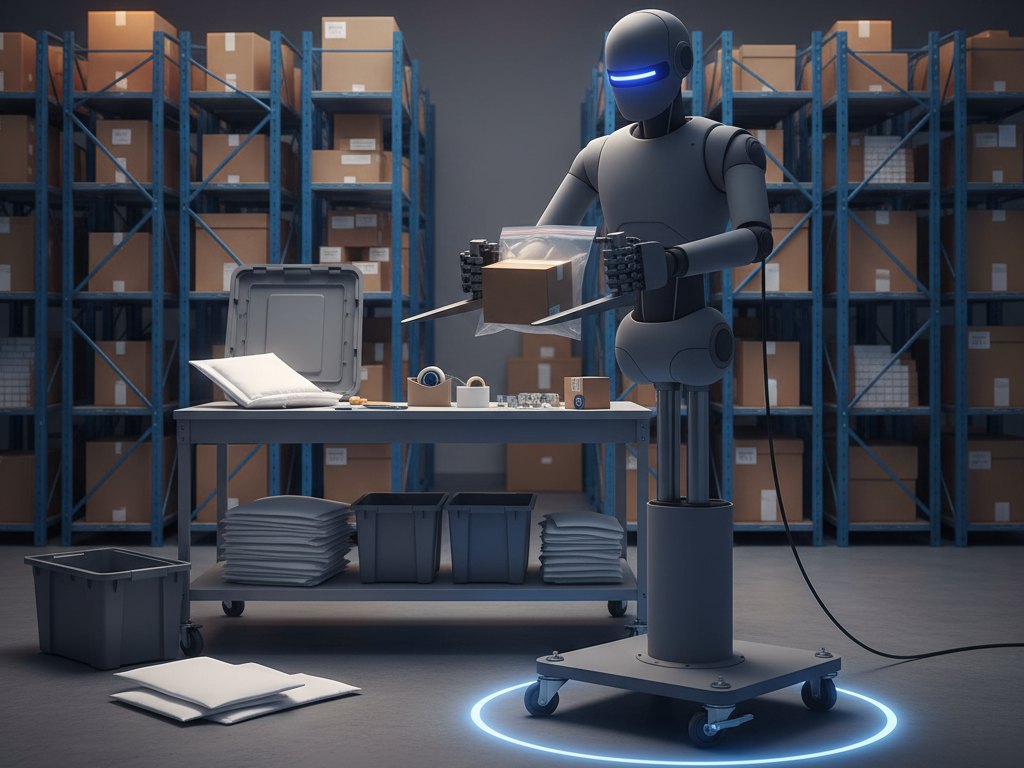
Ultra Robotics disclosed $62 million on October 9 for OP1, a two-armed packing robot that sits on locking casters at a human packing station, plugs into a 120-volt outlet and is leased by the month. The half-million-order count was mostly earned by three first-generation machines, the autonomy figure is one shift, remote pilots cover the rest, and the AI is rented from Physical Intelligence. It is still the design doing paid work at volume while walking humanoids wait for early access and safety rules.
Ultra Robotics said on October 9 that it has raised $62 million, a $50 million Series A led by Framework Ventures with Y Combinator participating plus an earlier $12 million seed led by Y Combinator and NextView, for OP1, a two-armed packing robot that cannot walk, has no motor in its base, plugs into a wall outlet, and is leased to warehouses by the month (https://fortune.com/2026/10/09/ultra-raises-62-million-fast-growing-robots-service-tie-up-ai-research-firm-physical-intelligence/, reprinted by Framework at https://www.framework.ventures/writings/ultra-raises-62-million-for-fast-growing-robots-as-a-service-business-announces-tie-up-with-ai-research-firm-physical-intelligence; https://siliconangle.com/2026/10/09/warehouse-robot-maker-ultra-robotics-bags-62m/). The company says its robots have packed more than half a million e-commerce orders, and the AI that runs them comes from Physical Intelligence, the model company last valued at $5.6 billion, per Fortune.
Three qualifications belong in the same breath. Most of those orders were packed by three first-generation machines called Packman, and the second-generation OP1 was announced only on April 15 (https://www.linkedin.com/posts/mfriefeld_we-started-ultra-in-a-garage-with-four-founders-activity-7450229873425477633-3Llg). The 96.4 percent autonomy figure Ultra and Physical Intelligence both published describes one eight-hour shift. Remote human pilots cover whatever the model cannot do. We think those caveats make the case stronger, because the machines that got to real order volume did it parked at a station built for a person.
Our view: the AI packing robot already doing paid work at volume is the least cinematic design on offer, a pair of arms on locking casters, and the part of it that looks like the future, the model, belongs to someone else. Walking humanoids are still earning permission to stand next to people, a fight we have covered separately and will not re-argue here. The body that got to half a million orders never had to balance, and the brain inside it is on a lease too.
What OP1 is: two arms on a hand-rolled cart with a wall plug
SiliconANGLE describes OP1 as a machine that "resembles a humanoid robot attached to the end of a traditional robotic arm," with grippers shaped like forklift prongs. Ultra's spec sheet is short: a 5×5 ft footprint, a work area up to 10×10 ft, vertical reach from 0 to 10 ft, a standard 120V outlet at 10A peak draw, a dedicated 10 Mbps ethernet line, up to 10 lb per arm, and locking caster wheels (https://www.ultra.tech/). That is about 1,200 watts at peak (arithmetic). There is no engine in the base. Workers roll the robot between sections by hand, and once it is in place the wheels lock to keep it from tipping, per SiliconANGLE. Ultra's product page puts it in four words: "Always on. Never on its side."
The task list is narrow on purpose: sorting mixed inbound containers into single-item bins, kitting items from different containers into one parcel, and final packaging, which means placing items, sealing the package and adding a shipping label, per SiliconANGLE. Co-founder and COO Max Friefeld's launch post names polybags, padded and paper mailers, folding boxes, and sorting packages. At one New York site OP1 "splits its time between bulk polybagging with an autobagger, and padded mailer packing from totes," and Ultra lists deployments in New York, Georgia, New Jersey and Texas. The company claims one unit can process up to 1,000 items a day, about 42 an hour if it ran around the clock (arithmetic). Setup takes "a few hours." Ultra's Y Combinator profile says it uses "reliable off-the-shelf hardware" so it can concentrate on deployment speed (https://www.ycombinator.com/companies/ultra).
The integration is what a 3PL operator will care about. At Highline Commerce, a Brooklyn fulfillment house, the robot "browses the WMS as if it was a human packer": it scans a tote, pulls up an order, scans to verify, and triggers shipping-label creation (https://www.automatedwarehouseonline.com/highline-commerce-uses-ultra-robotics-op1-logistics-industry-city/). Founder Richard Hurley: "In a packing station built for humans, it can grab a box and a label without needing to change anything." We argued in https://roboterminal.app/posts/sanctuary-industrial-arms that software on fixed arms beats new bodies on deployment tempo. Ultra took the fixed arm, put it on casters so the customer can shove it to the next station, and left balance to other people.
The half-million orders came mostly from three robots that are not OP1
Fortune's "more than half a million orders" is the headline number. The trail behind it runs through three statements. On April 15, Friefeld wrote that Ultra deployed its first system, Packman, six months after starting "in a garage with four founders," and that "our first 3 Packman robots have packaged over 300,000 e-commerce orders." The same post introduced OP-1 as a second-generation robot "rebuilt from the ground up." On July 23, CEO Jon Miller Schwartz told Automated Warehouse: "We scaled up to three robots that packed or shipped 500,000 orders." On October 9 the figure was "more than half a million."
So the fleet that earned the count is three machines of the previous design. April 15 to July 23 is 99 days; about 200,000 orders in that window is roughly 2,000 a day across three robots, or around 670 per robot per day (arithmetic). Treat that as rough, since the totals are rounded and the wording moved from "packaged" to "packed or shipped." The October figure is no larger in order of magnitude than July's, so no growth number has been disclosed since July and OP1's own output is not visible (arithmetic). That is the biggest gap in what Ultra has said.
The speed is still unusual. RobotHOT dates the founding to June 2024 (https://www.robothot.com/warehouse-robotics-startup-ultra-raises-62-mln-deepens-physical-intelligence-partnership), and Ultra went through Y Combinator's Summer 2024 batch. Schwartz and Friefeld previously co-founded Voodoo Manufacturing, and NextView partner Lee Hower, backing them for the second time, says Ultra "went from concept to multiple deployed robots generating revenue in under a year" (https://nextview.vc/videos/founder-investor-interview-lee-hower-nextview-ventures-x-ultra-co-founders/). Founding to Series A took about 28 months (arithmetic). The stated targets run well ahead of the disclosed record: 100 deployments by the end of 2026, per Automated Warehouse, and "hundreds and then thousands this year and beyond" in Schwartz's April post (https://www.linkedin.com/posts/jmschwartz11_proud-to-share-what-weve-been-working-on-activity-7450221199747411968-yRtM).
The lease: an integration fee, a monthly fee, and one customer that showed the terms
Fortune gives the model in one sentence: clients pay an up-front integration fee for Ultra to install the robots, then a monthly fee for hardware and software support. Schwartz says Ultra has booked revenue, will not say how much, and has been able to raise prices. Humanoids Daily and Robot Harbour both note that revenue and contract pricing are not public (https://www.humanoidsdaily.com/news/ultra-50-million-series-a-warehouse-robots-physical-intelligence; https://robotharbour.com/ultra-robotics-50m-warehouse-deployments/). The product page offers a trial: "Try it out for 3 months. Scale up when you're ready."
Highline is the one customer that has described its deal. It runs three Ultra systems in Brooklyn under a robots-as-a-service contract that "initially started with a per-order fee to incentivize Ultra to improve performance and has since moved to a monthly service fee, which encourages high utilization," per Automated Warehouse. Per-order pricing put the risk of a slow robot on Ultra. A flat monthly fee puts the incentive to keep the machine busy on the customer. A customer only accepts that trade once it trusts the robot to show up for work.
Hurley's reason for picking a parked robot over a mobile one is the operator's version of our thesis: "We couldn't get the economics to work for mobile robots. It's a bigger lift to standardize an entire warehouse versus a standardized packing station." Highline renewed at Industry City in July for 60,000 square feet at an asking rent of $35 per square foot (https://commercialobserver.com/2026/07/highline-commerce-lease-expansion-industry-city/). If that is per year, the usual New York convention and our assumption, OP1's 25 sq ft footprint occupies about $875 a year of floor, and its full 100 sq ft work area about $3,500 (arithmetic). Floor is cheap. Feeding the machine is the hard part. Highline hired a robot manager, and Hurley says "The biggest challenge is to make sure the robot is fed [products]." He has "an order for more robots for peak season" and is "counting on them for thousands of orders a day." An Industry City spokesperson told Commercial Observer the robots fill up to 30 percent of Highline's clients' orders, a figure Robot Harbour rightly says "does not establish performance across Ultra's fleet."
The brain is rented, and the data flows back to the landlord
Fortune calls the arrangement "body and brains." Ultra builds and installs the robots and relies on Physical Intelligence for the AI that adapts them to each customer's setup. PI, founded by a team from Google DeepMind, supplies "numerous other robot makers" as well, and in return "gets out-of-the-lab data to better train its models." PI's February 24 post, "The Physical Intelligence Layer," makes the pitch explicit: its models should become a ready-made layer roboticists use "in the same way that developers use API-based LLMs" (https://www.pi.website/blog/partner).
Ultra wrote its own section of that post, and it carries the number everyone quotes: π0.6 "packaging orders at Ultra's customer site for a full shift at 96.4% autonomy." Ultra's LinkedIn the same day called it "a full 8-hour shift, during which the robot operated autonomously 96.4% of the time" (https://www.linkedin.com/feed/update/urn:li:activity:7432209489723887616). That leaves about 17 of 480 minutes not autonomous (arithmetic). Humanoids Daily is right that the figure "describes the reported shift, rather than a guarantee across its fleet," and Robot Harbour notes it is not established as an OP1 result. The date supports the caution: February 24 is seven weeks before OP1 was announced (arithmetic).
People fill the gap, and Ultra says so. Friefeld in April: "up to 97% autonomy in the field (and we run 100% by supplementing with a remote pilot team)." At Highline, autonomy depends on the brand. Subscription floss heads are "handled completely autonomously." Elsewhere "Ultra had a guy teleoperate the system until it got the model to where it wanted," and performance went "from working maybe 70% of the time at first to a level in the 90% range," with "a three-month turnaround from introduction to filling orders reliably." Schwartz: "We're very confident that teleoperation provides a pathway to high-level autonomy," and simulation "is not good enough to accurately represent real-world manipulation."
Then there is the second cable. OP1's network link shares sensor data that Ultra uses to improve the models, per SiliconANGLE, and PI's post says adding Ultra's data to pre-training raised items-per-hour throughput and that π0.6 meant "less fatigue for our remote intervention team." PI reports the same loop at its laundry partner Weave, where partner data cut interventions 50 percent. Highline's orders become training data, the next model lifts Ultra's throughput, and the model company keeps the improved model. PI raised a $600 million Series B led by CapitalG in November 2025 at about $5.6 billion, per Bloomberg via The Robot Report (https://www.therobotreport.com/physical-intelligence-raises-600m-advance-robot-foundation-models/), and was reported in March to be in talks above $11 billion, roughly double (arithmetic), with co-founder Lachy Groom saying there was no timeline for commercialization (https://techcrunch.com/2026/03/27/physical-intelligence-is-reportedly-in-talks-to-raise-1-billion-again/). Our view: the price of the brain is the largest undisclosed number in Ultra's business, bigger in consequence than payload or autonomy.
OP1 against Digit 5, row by row
Agility's Digit 5 is the most fully specified walking warehouse humanoid on the record, so it is the fair comparison (https://www.agilityrobotics.com/content/agility-unveils-digit-5-humanoid-robot-built-for-cooperatively-safe-work-at-scale). Where the sources say nothing, the row says so.
| Ultra OP1 Operator | Agility Digit 5 | |
|---|---|---|
| Base | Flat wheeled base, no motor; rolled by hand; casters lock | Biped; 284 lb (129 kg), 5'11" (1.81 m) |
| Tip and fall risk | Stationary design "eliminates risk of tipping" | Avoids, stops or sits down when it detects a person; its class is defined as one that "could become unstable in the absence of power" (https://www.iso.org/standard/91469.html) |
| Power | 120V outlet, 10A peak (about 1,200 W, arithmetic); no battery | 90-minute battery, 9-minute charge; about 9 of every 99 minutes on the charger (arithmetic) |
| Payload | Up to 10 lb per arm, 20 lb combined (arithmetic) | Up to 50 lb (22.7 kg) |
| Install | "A few hours"; roll in, plug in; uses the existing WMS like a human packer | Not disclosed |
| Commercial model | Integration fee plus monthly fee; 3-month trial; prices not public | More than $300M in multi-year orders as of May 2026, "subject to satisfaction of certain contractual milestones" |
| Orders shipped claim | More than 500,000, mostly by three Packman units; one shift at 96.4% autonomy | Not disclosed as orders; Digit 4 logged more than 65,000 hours, 100,000 totes at GXO Flowery Branch |
| Availability | Deployed now in NY, GA, NJ, TX; 100 deployments targeted by end of 2026 | Early access H1 2027; general availability by end of 2027 |
Two rows carry the argument. The tip row is where the safety rulebooks are stuck. Seoul Economic Daily's explanation for why Korea needed an October 13 sandbox to let 20 humanoids work without a fence was that "Current safety standards for industrial robots assume stationary machines" (https://en.sedaily.com/finance/2026/10/13/korea-clears-first-factory-test-of-20-humanoid-robots). OP1 is the stationary machine those rules assume. Agility co-founder Jonathan Hurst has called safety a "blocker for everybody" (https://arstechnica.com/ai/2026/09/agilitys-new-humanoid-robot-will-stop-squat-to-avoid-harming-human-coworkers/). The availability row is the other: Digit 5 reaches early customers next year, while OP1 has a peak-season order at a Brooklyn 3PL now. The IFR counted about 7,000 full-size humanoids sold worldwide in 2025 and said "most current applications remain specialized and often require human teleoperation" (https://ifr.org/ifr-press-releases/news/global-sales-of-professional-service-robots-surge-24-percent). Schwartz says humanoid scaling needs about five years, so around 2031 (arithmetic). That seems a fair guess, from a man with an interest in it.
Objection docket
"No revenue and no prices, so there is no business to judge." Conceded in part. Schwartz declined to size revenue, and contract pricing is not public. What is visible is the structure (integration fee plus monthly fee), the direction (prices raised) and one customer moving from per-order to monthly. That is thin. It is also more than most humanoid makers have said about any paying deployment.
"The autonomy number is one shift from before OP1 existed, and a pilot team covers the rest." All true. Ultra's "100%" is Ultra plus people. The more honest record is Highline's arc: 70 percent at first, the 90 percent range after three months, some items fully autonomous and others not. The IFR's teleoperation line fits Ultra too. The difference is that Ultra's pilots supervise a robot that is already billing a customer, and the cost of that supervision as the fleet grows is the variable Humanoids Daily flags.
"The half-million orders belong to Packman, and the 30 percent is the customer's number." Yes on both. The 30 percent came through an Industry City spokesperson and says nothing about Georgia, New Jersey or Texas. We read the order count as proof that a parked, plugged-in form factor works at volume, and treat OP1's own record as unproven until Ultra publishes a number from the new fleet.
"Ultra does not own its brain, and PI sells to everyone." This is the strongest objection and we cannot fully answer it. Ultra's customer data improves PI's pre-training, so part of the moat Ultra is digging sits on PI's land. Ultra keeps the hardware, the installs, the customer relationship and, per Fortune, enough demand to raise prices. Whether that holds depends on terms neither company has published.
"Ten pounds per arm is a cobot cell with a better story." The payload is small; 20 lb combined against Digit 5's 50 lb rules out a lot of warehouse work. The claim here is narrower. Ultra's own account says e-commerce packaging "has historically been impossible to automate" because of a long tail of items, workflows and floppy packaging, and that a learned policy improves "with data scale rather than engineering hours." A robot that reads the WMS, bags mixed items from totes and rolls to the next station is a different purchase from a fixed cell, if the autonomy numbers hold.
Three things to check
- A current deployment count against the target of 100 by December 31 2026, and Highline's peak-season result. Ultra has not published a fleet count; its last stated target, in July, was 100 by year end. Hurley expects "thousands of orders a day" at peak. Both numbers would show whether OP1 scales past one Brooklyn customer.
- An order count or autonomy figure that comes from OP1 and is dated after April 15 2026. Every published volume figure traces to three Packman units, and the only shift-level autonomy number is from February. One OP1 number would settle whether the rebuild kept pace with the original.
- Physical Intelligence's next priced round and any disclosed terms of the "deepened" Ultra partnership. The March talks above $11 billion have not been confirmed as closed. A price for PI's models, or any published term with Ultra, would show who keeps the margin on each packed order.
The $62 million buys more casters, more installs and more hours of data on how a polybag behaves in a gripper. It does not buy the model. Ultra settled the body question early by refusing to build a body that walks. The question it has not settled is what the brain will cost once the company that owns it decides to charge.
Sources
- Fortune, Ultra raises $62 million
- SiliconANGLE, Ultra Robotics raises $62M
- Ultra, OP1
- Physical Intelligence, The Physical Intelligence Layer
- LinkedIn, Ultra post
- LinkedIn, Ultra co-founder post on the start in a garage
- Framework Ventures, Ultra raises $62 million
- LinkedIn, Ultra co-founder post
- Automated Warehouse, Highline Commerce uses OP1
- Commercial Observer, Highline Commerce Industry City lease
- Humanoids Daily, Ultra's $50M Series A
- Robot Harbour, Ultra Robotics warehouse deployments
- RobotHot, Ultra raises $62M
- Y Combinator, Ultra company page
- NextView Ventures, interview with Ultra's co-founders
- The Robot Report, Physical Intelligence raises $600M
- TechCrunch, Physical Intelligence in talks to raise $1B
- Agility Robotics, Digit 5 launch
- Ars Technica, Agility's Digit 5 stops and squats near coworkers
- Seoul Economic Daily, Korea clears first factory test of 20 humanoids
- ISO, ISO/CD 25785-1
- IFR, professional service robot sales
- Roboterminal, Sanctuary and industrial arms